Yet Another Reason to Control Invaders
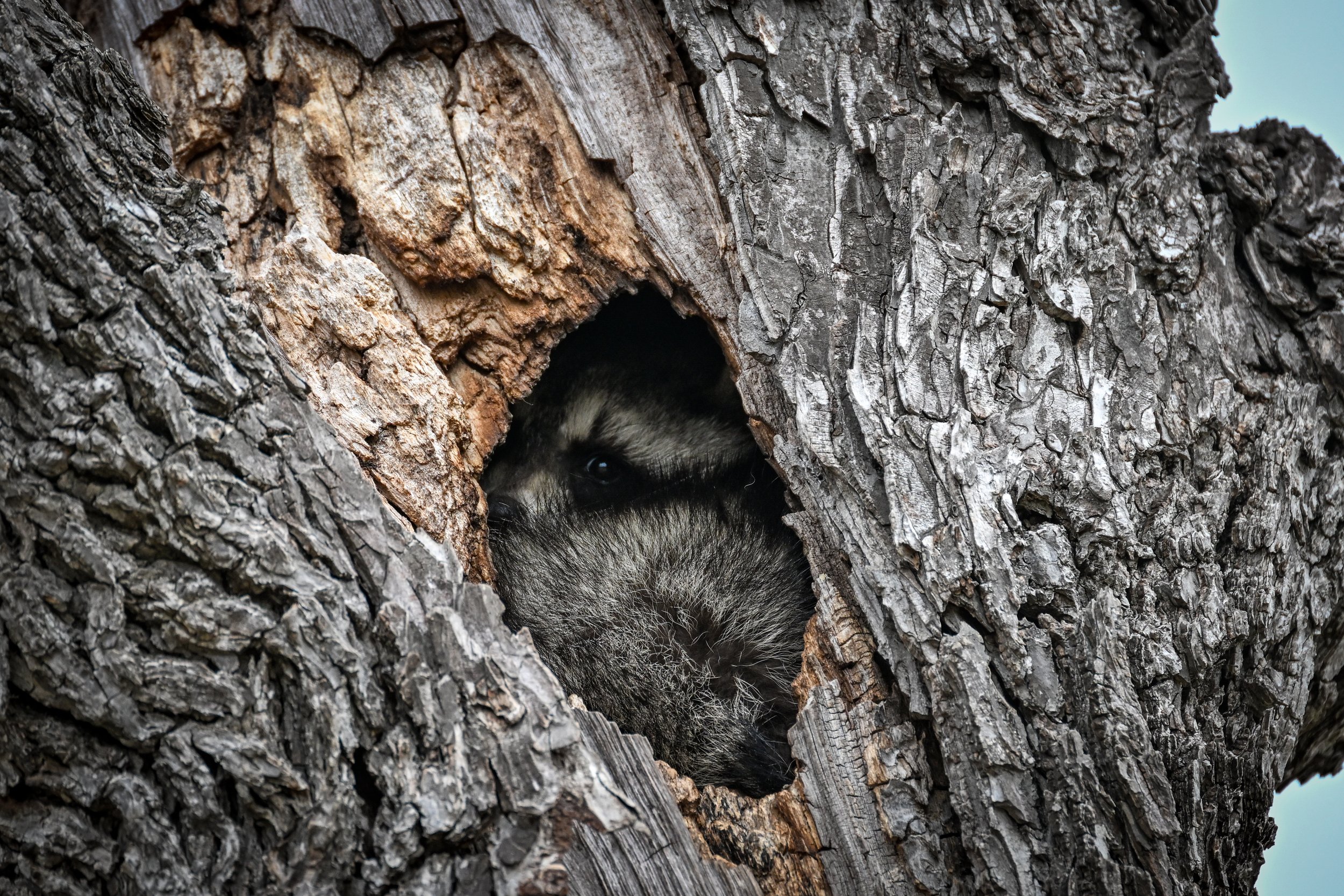
Photo courtesy Betsy Cross
“If you are at all interested in contributing to the conservation of local animals, or in enjoying the wonders of nature right at home, planting one or more oaks is an awfully good way to do those things.” —The Nature of Oaks, Douglas Tallamy
Christine Middleton
Trees provide us with shade. But they do so much more! Trees sink water, build soil, and sequester carbon. These and other benefits were discussed in an earlier article, Trees Are More Than Pretty. The article touched briefly on the benefits to wildlife. But that topic deserves more in-depth exploration, as a wide range of creatures—from tiny insects to deer to just about everything in between—rely on the presence of trees.
Many species of butterfly and moth caterpillars hatch from eggs laid on trees, thrive by consuming their leaves, and pupate in the leaf litter that gathers underneath. That’s why Doug Tallamy loves oaks. Oaks host more caterpillars than any other plant. That’s important because caterpillars are a bridge in the food web between flora and fauna.
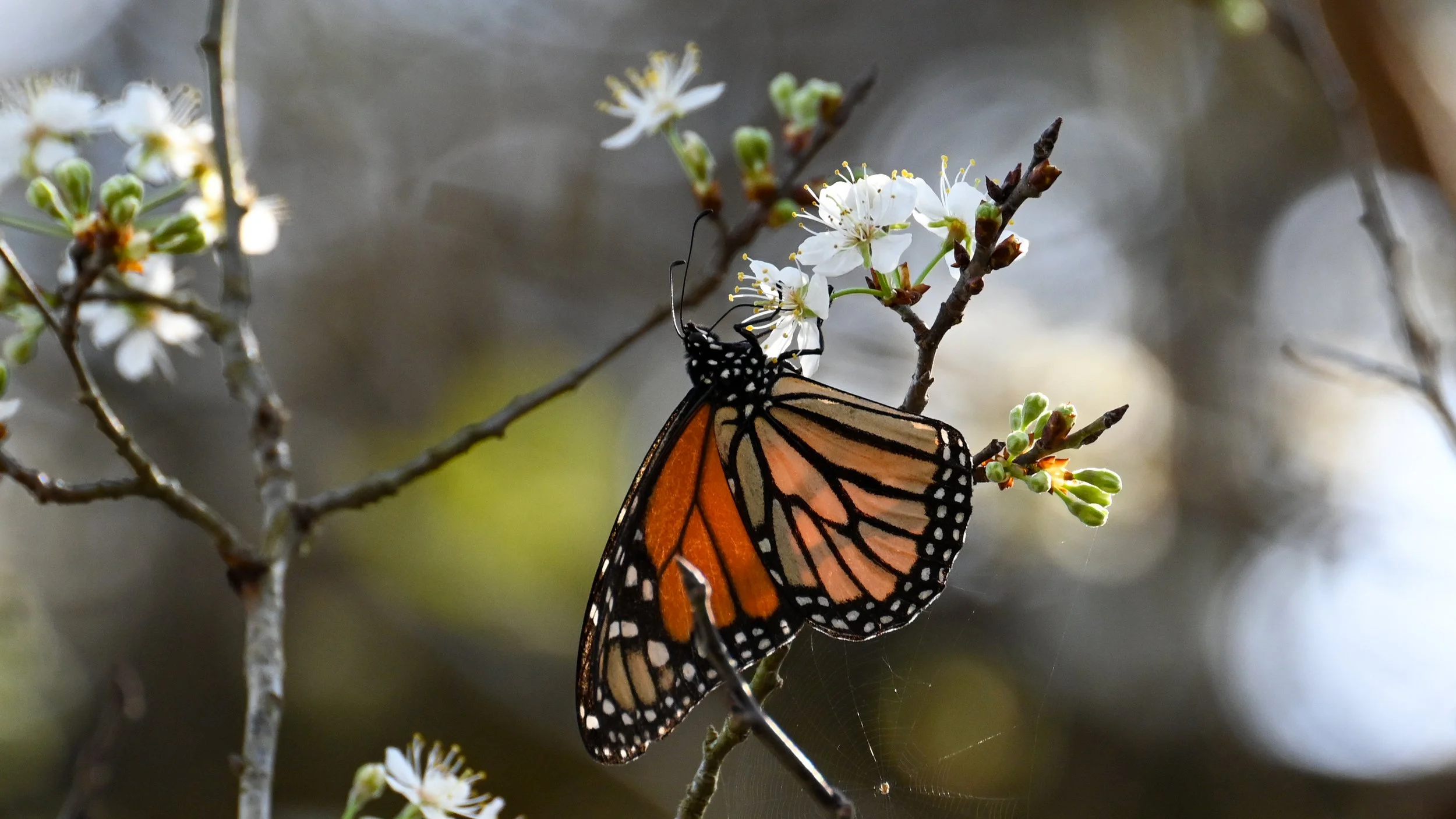
Photo courtesy Betsy Cross
Many songbirds eat caterpillars, and most feed them to their nestlings. And caterpillars aren’t the only food trees provide. The nectar and pollen found on flowering trees attract a variety of pollinators. Birds, squirrels, deer, and lots more critters depend on tree fruits and nuts, especially in the wintertime when other food sources are scarce.
Trees also serve as safe havens, places to hide and to raise the next generation. Birds can quickly fly onto higher branches when threatened. Some mammals have skeletal structures that facilitate quick getaways. Trees provide refuge from hot summer days or cold winter winds. And a tree branch or natural cavity is a great place to raise the next generation.
Native trees have evolved alongside the wildlife they support. Different trees support different creatures, so a diversity of native tree species is desirable. Non-native tree species—trees that have more recently moved here—are a mixed bag. Generally, they don’t support as many insects, if any, thus undermining the base of local food chains. And some misbehave by invading natural areas, adding insult to injury by crowding out native vegetation.
Let’s Start with Caterpillars
Doug Tallamy suggests caterpillars are a “keystone species.” What is a keystone species? Like the keystone in a Roman arch, a keystone species is a plant or animal whose absence would cause a whole food web to collapse. Caterpillars are not only a much-preferred bird baby food. Parasitoid insects actually lay their eggs in or on caterpillars as a way of providing fresh food for their larvae. Insects like wasps and ants, as well as spiders, prey on those juicy morsels and often become prey themselves for birds. Frogs, toads, and lizards snack on caterpillars, as do small mammals like mice.
Tallamy suggests there is “… no better way to share our space with insects than to plant an oak.” Why? One part of that answer is that more species of caterpillars feed on oaks than any other type of plant. In Hays County, trees in the genus Quercus (oaks) host a total of 468 different species of butterflies and moths. Next in line are plums and cherries (Prunus) with 270 species and willows (Salix) with 229 species. By comparison, the top performers among non-tree genera are goldenrod (Solidago) and sunflowers (Helianthus) at 82 and 81 caterpillar species, respectively.
Both living and dead, leaves support a variety of caterpillars. Many of the caterpillars that eat tree leaves pupate under the same trees where they hatched. Upon reaching maturity, such caterpillars climb or drop down to the ground. Some caterpillars push their way into the soil to pupate underground, assuming the soil around the tree is not too compacted. Others spin their cocoons in the leaf litter that has collected under the tree, if nobody raked it all up.
The Double-lined Prominent Moth provides a glimpse of the life cycle of a tree-loving caterpillar. Life begins when the female Prominent moth lays 30-300 eggs on the underside of a leaf on the host tree. Upon hatching, a swarm of tiny caterpillars, black with numerous red, yellow, and white spots, emerges. These tiny creatures (about 3/4 of an inch long) feast gregariously, often skeletonizing leaves in the process.
The tiny caterpillars grow rapidly and change dramatically as they go through 5-6 instars over a period of 3 to 4 weeks. Their behavior becomes more solitary, and they often consume entire leaves, creating a noticeably barren branch. The Prominent caterpillar’s body grows to a length of 1 1/2 to 2 inches and transitions to green, reddish brown, or chocolate with two narrow white or yellow stripes along the sides.
Upon maturity, these now gorgeous creatures fall to the ground. In our area at the southern end of their range, Prominent moths are bivoltine, meaning they produce two generations per year. Both pupate primarily in leaf litter or sometimes just slightly beneath the soil surface. Those that mature late in the season form silken cells where they spend the winter in this pre-pupal stage, protected by the fallen leaves until warmer weather returns.
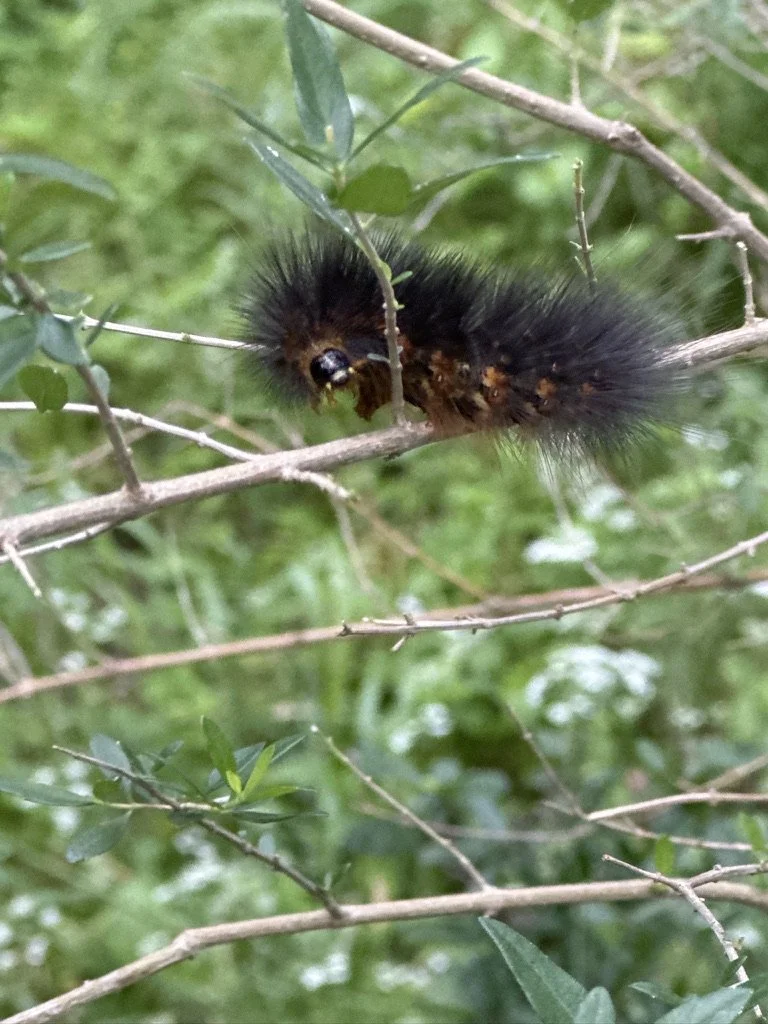
Salt Marsh Ermine caterpillar Photo courtesy Christine Middleton
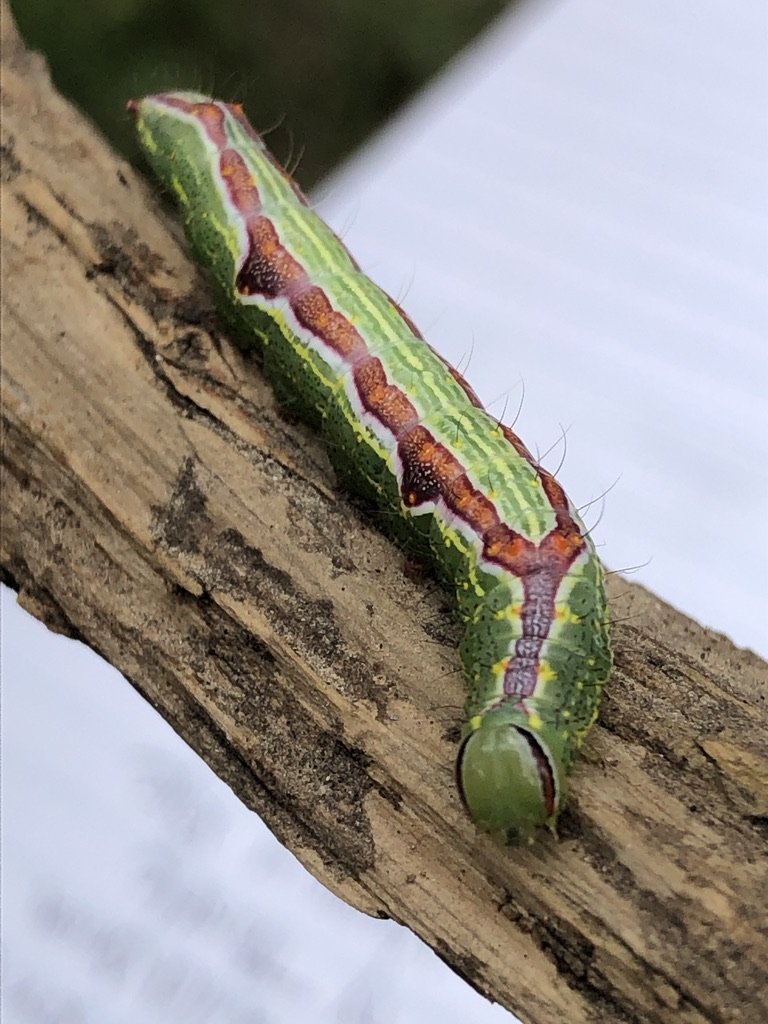
Double-lined Prominent caterpillar Photo courtesy Christine Middleton
Two moth caterpillars with very different tastes: the Salt Marsh Ermine caterpillar uses a variety of different plant types, including trees in the genus Malus (apple), and in Central Texas, the Double-lined Prominent caterpillar uses only oaks (Quercus) and elms (Ulmus).
Pollinators vs. Deer
Pollinators love wildflowers. But they also love a subset of our native trees. Wind-pollinated trees like oaks and elms invest their energy in creating huge quantities of pollen that often cause us to sneeze. Insect-pollinated trees use their energy to create showy petals, strong fragrances, and lots of nectar concentrated on just one plant. Have you ever stood near a Texas Redbud (Cercis canadensis var. texensis) or Texas Mountain Laurel (Dermatophyllum secundiflorum) in bloom and marveled at how the profusion of fragrant blossoms has attracted a host of bees, butterflies, and other insects?
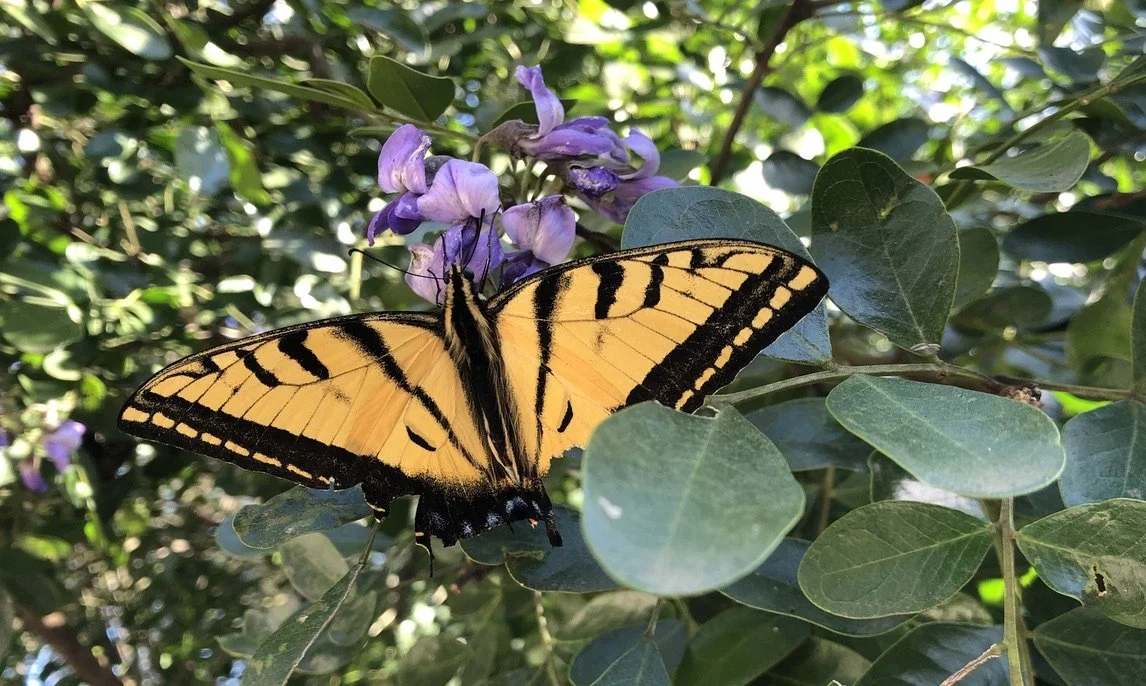
Photo courtesy Christine Middleton
Most insect-pollinated trees are small and tend to grow in the shade of larger wind-pollinated ones. Some, like Rusty Blackhaw (Viburnum rufidulum), Mexican Buckeye (Ungnadia speciosa), and Texas Persimmon (Diospyros Texan), can take the form of either small trees or shrubs. Most insect-pollinated trees bloom in springtime. But pollinators need nectar in the summertime too. A tree that fills the bill is Gum Bumelia (Sideroxylon lanuginosum), which was featured in an August 2022 Hays Humm article entitled It’s Blooming Hot.
Like pollinators, deer depend on trees and other woody plants for sustenance. Browse, defined as the leaves and stems of trees and shrubs, makes up about 30%-50% of a deer’s annual diet. Mast (i.e., nuts, seeds, and fruit of woody plants) makes up another 5%-20%, depending on availability. The remainder of a deer’s diet consists of forbs (25%-50%) and grasses (less than 10%).
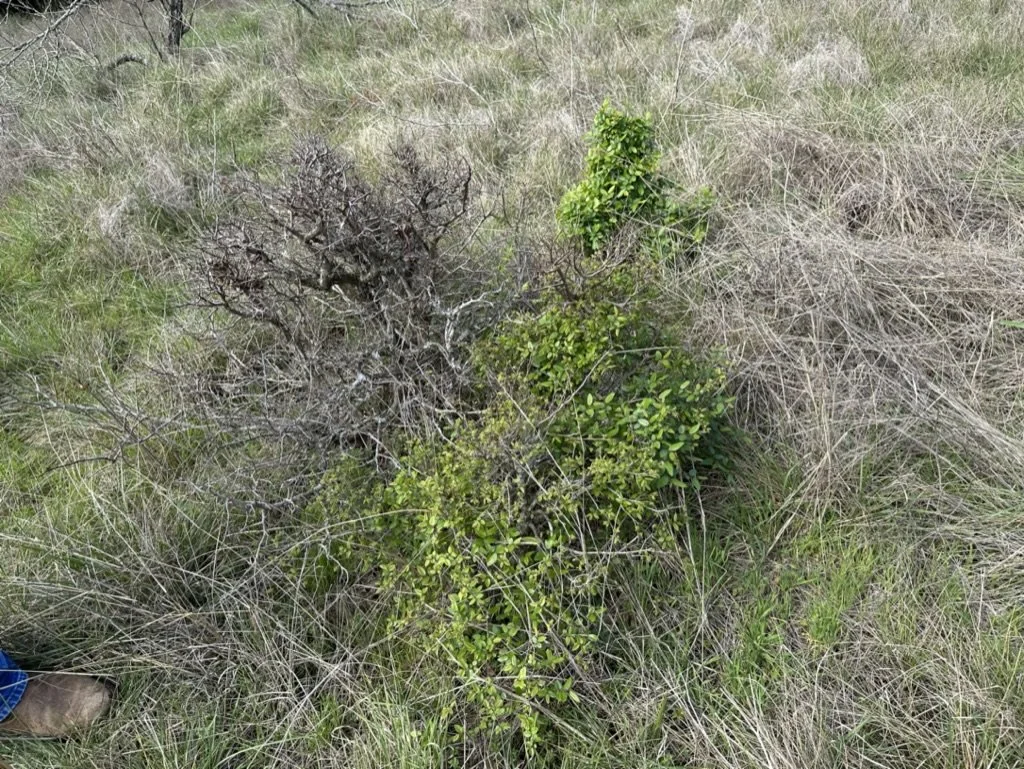
Cedar Elm at Dahlstrom Preserve
This Cedar Elm has been heavily browsed by deer.
Photo courtesy Christine Middleton
But what happens to trees when the number of deer exceeds the carrying capacity of a piece of land? Mature trees are spared, although their branches may start above the reach of the tallest deer, often referred to as the browse line. But their very survival is not threatened, at least not by deer. The next generation, the saplings that would eventually replace those tall trees, are not so lucky. Deer typically browse leaves, soft twig ends, and buds—the parts of the branch most responsible for next year’s growth. So, browsed too often, smaller trees don’t grow more than a few feet tall and often put up additional shoots in an effort to stay alive. And fragile sprouts never even get the chance to get going.
Steve Nelle was overheard asking a landowner concerned about deer if he had many red oaks on his property. After a “yes” answer, Steve followed up with, “But do you have young red oaks?” Hearing “no,” he quipped, “Then you have a deer problem.”
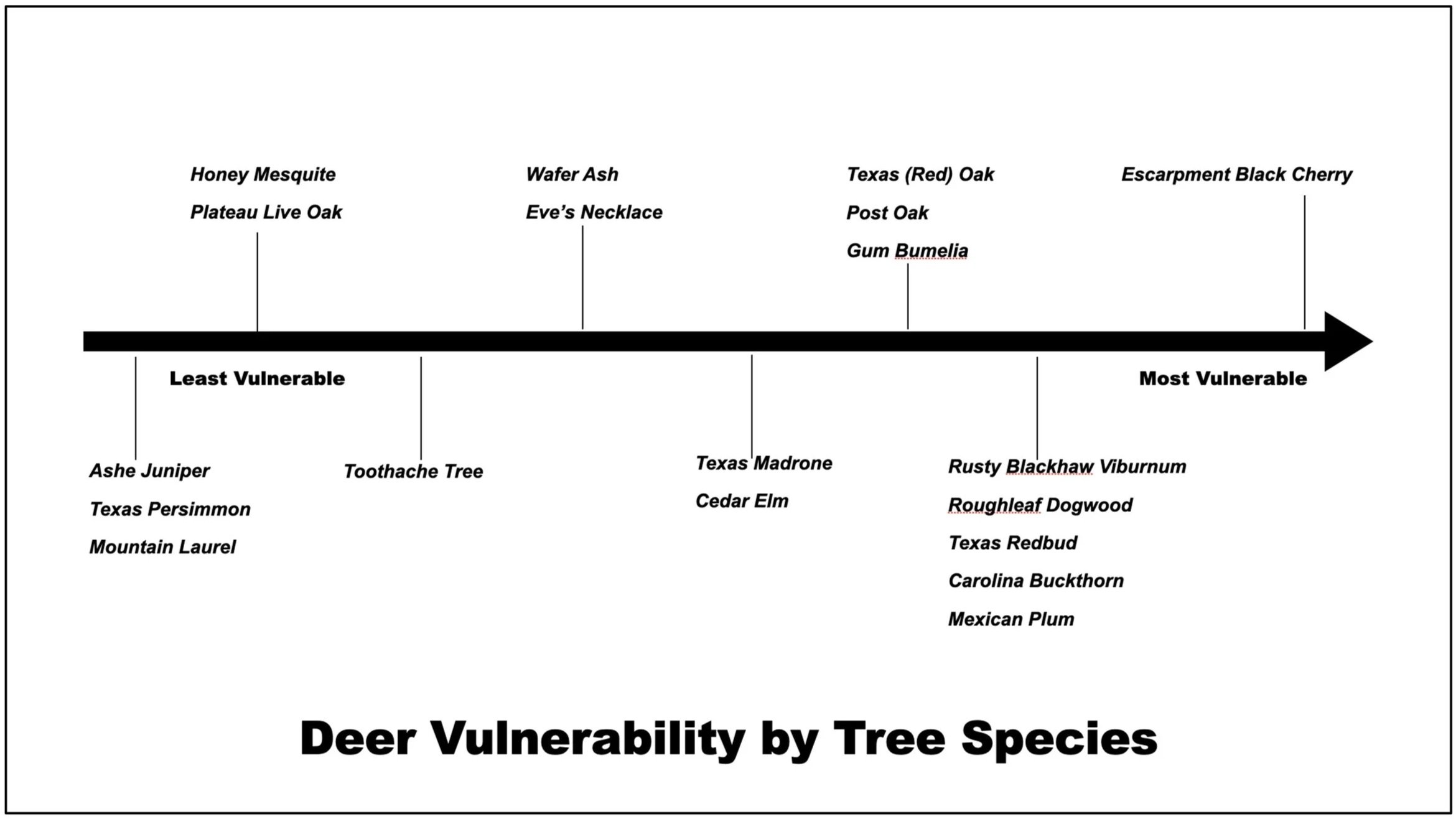
Image courtesy Christine Middleton
Deer definitely prefer some trees more than others. Often, the ones we are left with are their least favorite—primarily Ashe Juniper and Live Oaks. Of those favored by pollinators, the most likely survivors are Texas Persimmon, Mountain Laurel, and in the eastern part of Hays County, Honey Mesquite. But lots of other wonderful flowering trees are rapidly disappearing, except for lucky ones that happen to sprout in places deer don’t wander often—primarily busy roadsides and steep canyons.
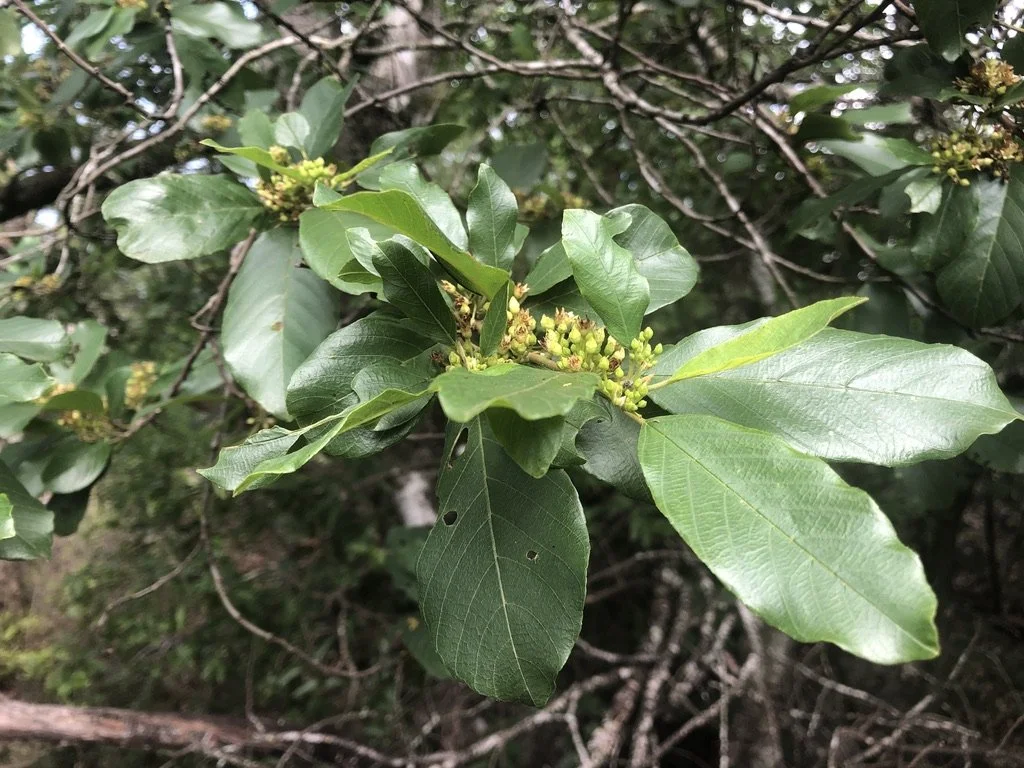
Carolina Buckthorn berries are a bird favorite. This one was found on the edge of a cliff at Karst Canyon, where it was beyond the reach of deer, who often love this species to death. Photo courtesy Christine Middleton
Insects, Birds, and Other Wildlife
Caterpillars, pollinators, and deer aren’t the only creatures dependent on trees. Just about everyone loves fireflies. But did you know that, like the Double-lined Prominent moth, firefly larvae spend the winter in leaf litter? And while some species of beetles and ants chew holes in trees, they also provide food for birds. And how would hummingbirds create their expandable nests if spiders didn’t use trees to support their webs? As discussed in Land Stewardship is for the Birds, Part 1, trees and other woody plants provide birds with food, shelter, and protection from predators.
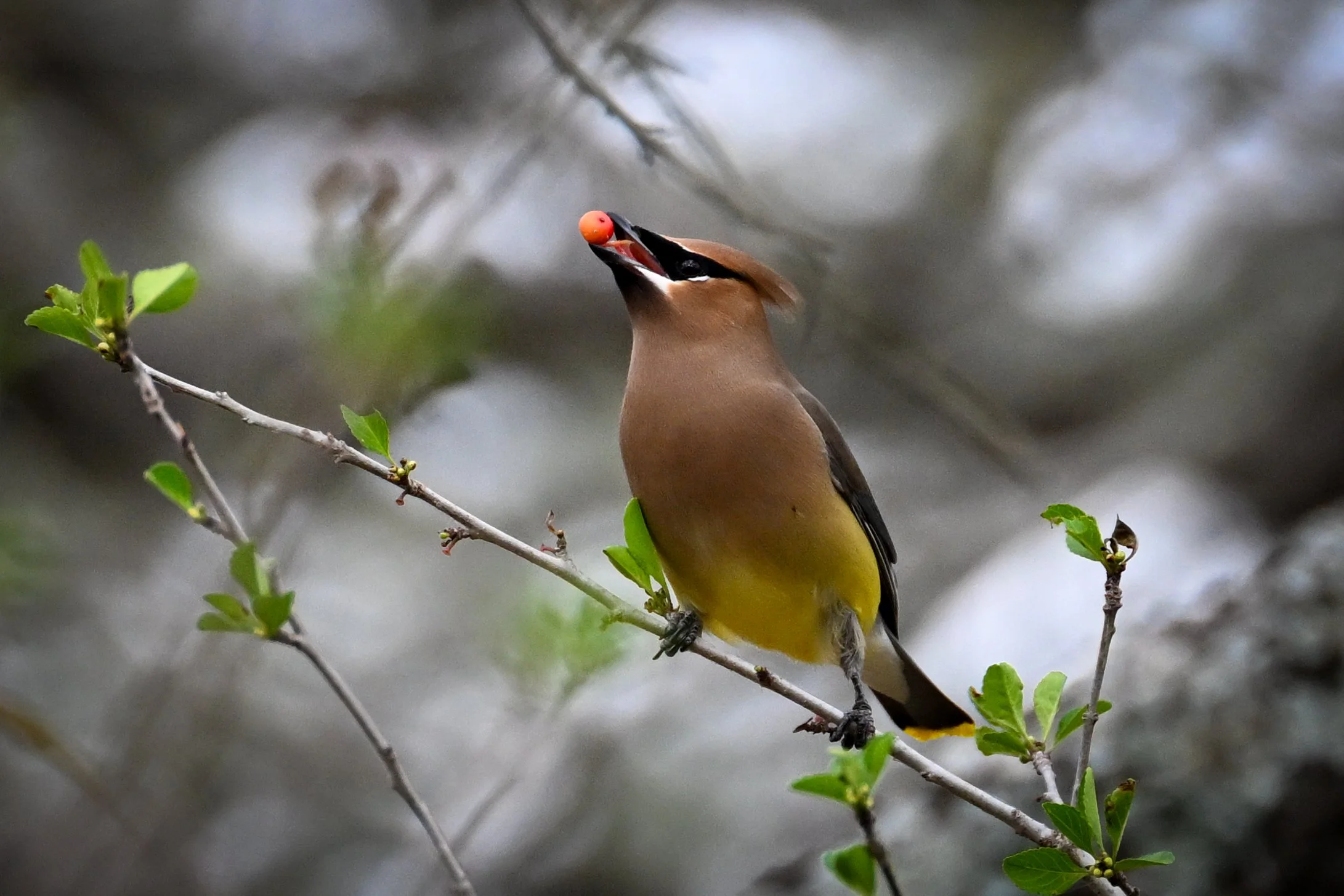
Photo courtesy Betsy Cross
Some birds, including turkeys, quail, ducks, blue jays, woodpeckers, and even titmice, are avid consumers of acorns. But these creatures aren’t the only ones who relish these valuable little packets of nutrient-rich food. Deer, squirrels, raccoons, foxes, porcupines, and opossums all include acorns as part of their diet. Tree-climbing mammals also find nourishment in trees. Not just nuts, berries, and insects, but also bird eggs and hatchlings.
To reach food, a subset of mammals have evolved anatomies that facilitate tree climbing. Opossums have sharp claws, opposable thumbs, and a prehensile tail that can be wrapped around branches for added stability. Opossums, as well as squirrels, raccoons, and ring-tailed cats, can rotate their legs 180 degrees. This makes them better tree climbers. But that’s not all! It also means they can descend head-first. Gray foxes are the only canines that climb trees, and they too descend head-first.
The ability to scurry up trees quickly means more time to escape. Natural cavities, whether close to the ground or higher up the trunk, make great places to hide from predators like owls, coyotes, and bobcats. Like cavity-nesting birds, squirrels, raccoons, and opossums sometimes raise their young in such tree cavities. Certain lizards and frogs, as well as snakes, also take advantage of such naturally created safe havens. And some bee and wasp species will place their hives in tree hollows.
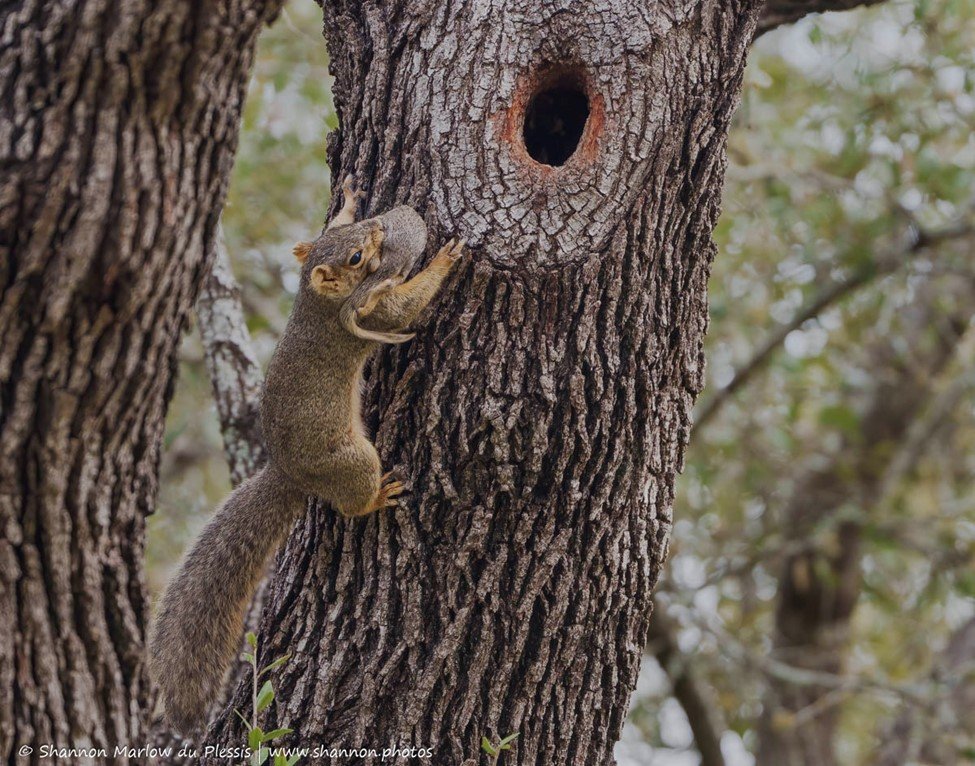
Photo courtesy Shannon Marlow du Plessis from The Move
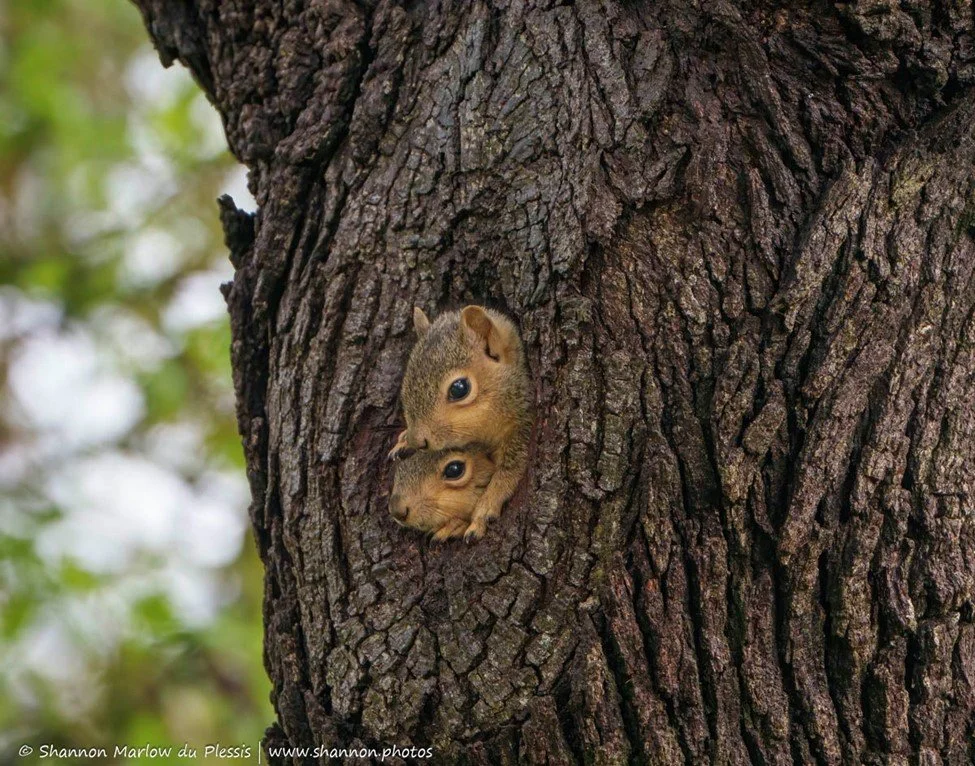
Photo courtesy Shannon Marlow du Plessis from The Move
Photos from The Move by Shannon Marlow du Plessis in the May 2023 Hays Humm
But Then There Are the Statues
Doug Tallamy describes non-native trees as “biologically inert.” He goes on to suggest you should think of such plants as “statues.” While some statues stay put, others are not so well-behaved. Spread by birds, wind, or water, the species relocate into parks and other natural areas, both public and privately owned. Once there, such invaders outcompete native trees, significantly altering wildlife habitats.
Non-native trees are popular in the nursery trade for a variety of reasons. Predictability and aesthetics play a big role, as does ease of production. But non-native trees don’t host many caterpillars, if any. Nor are other insects likely to be attracted to such foreigners. One of the most common ornamental landscaping trees is Crape Myrtle. People like it because it blooms all summer long. But Crape Myrtles host zero caterpillars. Sometimes Crape Myrtle flowers attract bees, mostly non-native honeybees. And birds rarely nest in the branches.
Other non-native trees have even less ecological value, and some cause significant harm. Chinaberry is one of the most common invasive trees found in Hays County. How did it get here? Native to East Asia, Chinaberry was introduced into the United States in 1790 and made its way to Texas around 1828. Chinaberry was planted around Texas homesteads and along its streets—valued for its shade and fragrant flowers.
Another often-seen invasive tree, Chinese Tallow, came to the U.S. even earlier. Benjamin Franklin was a fan of Chinese Tallow trees because their seeds are loaded with waxes good for making soap, candles, and edible oils. And just one Chinese Tallow tree produces a proliferation of such seeds—up to half a million per year. Both Chinaberry and Chinese Tallow spread by both seeds and root sprouts. And both species create unfavorable soil conditions for native plants, enabling them to win the competition for space.
In 1998, Texas declared Chinese Tallow a noxious and invasive weed. Chinaberry followed seven years later. Thus, under Texas Agricultural Code 71.152, selling, distributing, or importing either tree is a Class B misdemeanor. But others like Vitex (sometimes referred to as Lilac Chasteberry or Texas Lilac), Chinese Parasol Tree, and Tree Tobacco are still commonly found in area nurseries. Many other non-natives that are invading our wild spaces are also still sold legally.
A good example is a species of privet often seen invading Hays County natural areas—Glossy Privet (Ligustrum Lucidium). Birds and other berry-eating animals spread this invader far and wide. Once a seed finds a favorable location, it too spreads via root sprouts. Glossy Privet can take over large areas and is capable of getting as tall as 25-40 feet. It’s even been seen outcompeting Ashe Juniper!
Unfortunately, deer tend to prefer native trees and thus provide little help controlling invasive ones. One method for controlling privet, as well as other invasive trees, without chemicals is girdling. Girdling works by removing a strip of bark in order to interrupt the upward flow of water and nutrients, eventually leading to the tree’s demise. Not only is girdling more cost-effective and less dangerous, a dead or dying tree left standing, even one that is non-native, can attract boring insects, which in turn bring in woodpeckers that excavate much-needed cavities. Here’s the link to an instructional video produced by Austin Wildlands Conservation that explains the process.
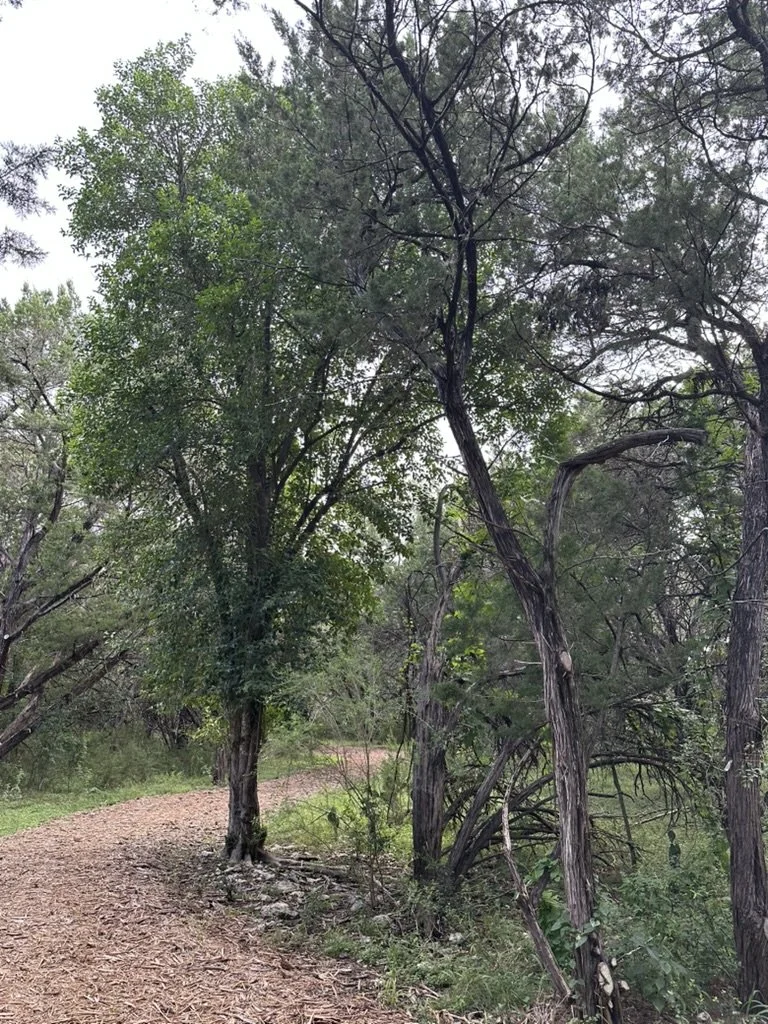
Large Glossy Privet growing close to the trail Photo courtesy Christine Middleton
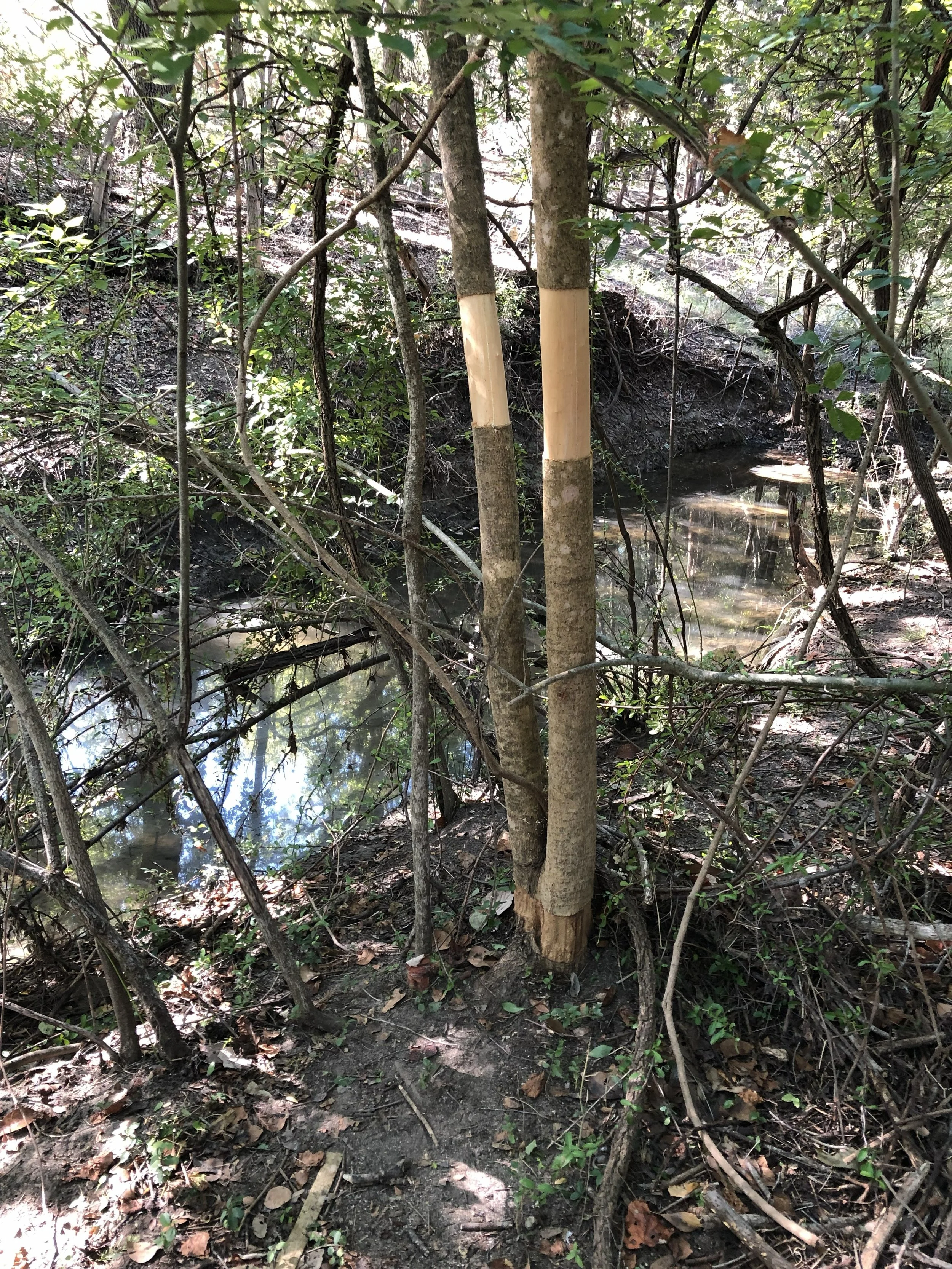
Recently girdled privet growing near a stream Photo courtesy Christine Middleton
Another method for controlling invasive trees involves felling the trees and carefully painting the cut stump with an herbicide. While mostly avoiding chemicals is a good idea, especially near streams, sometimes they are the best tool in the toolbox. Used correctly and sparingly, herbicides can do far less ecological damage than an invasive tree. Caterpillar-loving Doug Tallamy calls herbicides “plant chemotherapy.” He goes on to explain, “The chemicals we use to fight cancer are nasty but necessary, and they have to be used properly.” As with girdling, a good practice is to stop back by every so often to ensure the tree hasn’t somehow survived your deadly meddling.
Coming Soon — HELM 2026 Fall Visits
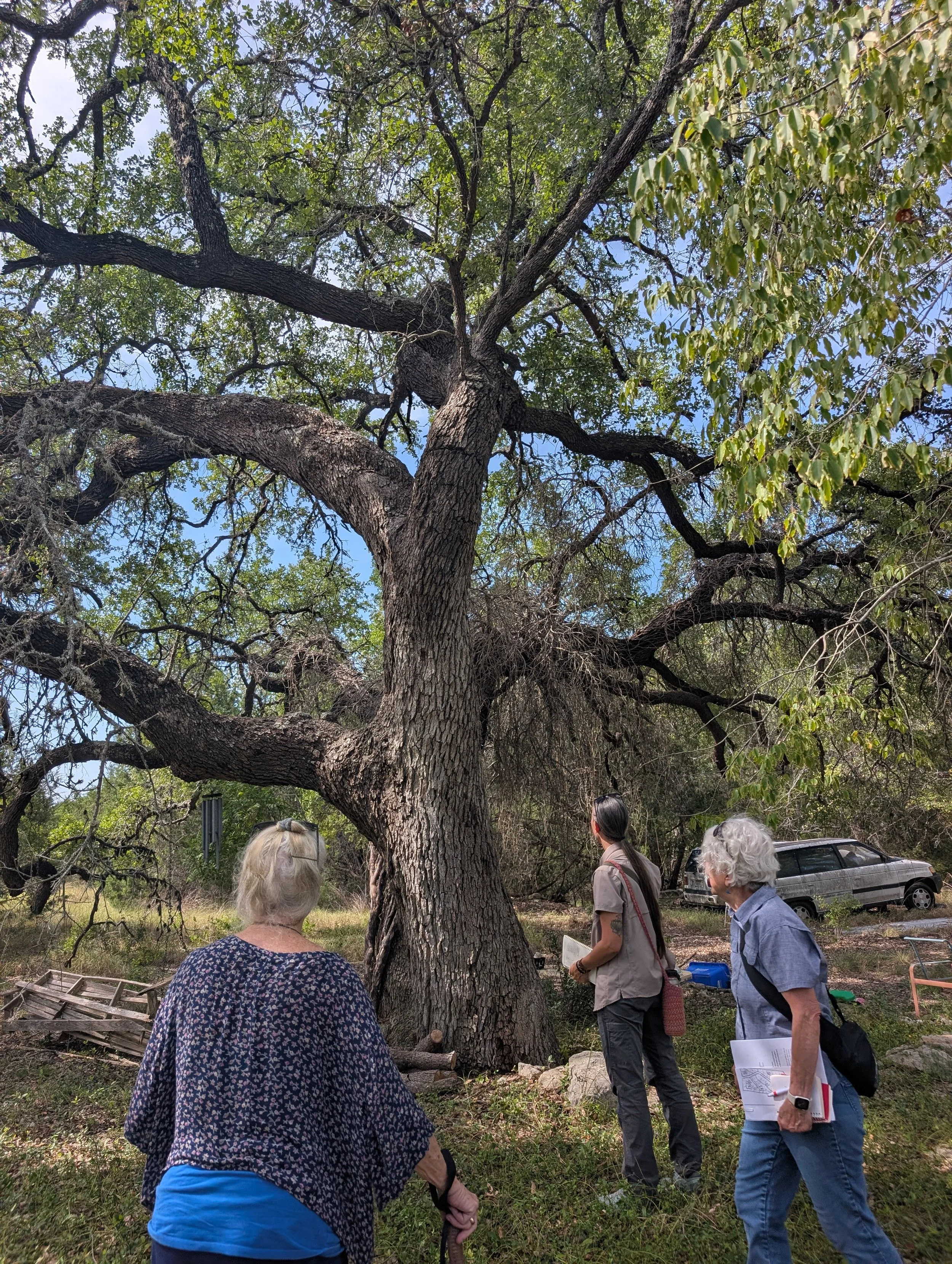
Photo courtesy Doray Lendacky
Increasing the diversity of native trees and controlling invasive ones are great ways to support the wildlife that inhabits your property. Mid-October through November is considered the best time of year to plant trees. That gives newly planted trees plenty of time to establish more resilient root systems well in advance of summer heat. And don’t forget to provide those young trees with protection from deer herbivory.
Own acreage in Hays County? We’d love to come and talk to you about your trees, as well as any other concerns you might have regarding stewarding your property. Under our HELM (Habitat Enhancing Land Management) program, the Hays County Master Naturalists offer property visits where landowners learn about sustainable practices designed to enhance wildlife habitat, effectively manage invasive species, improve soil, and much more.
We still have a few openings for our coming fall visits.
If you would like to schedule a HELM visit, fill out our request form at this link. And please help us spread the word to your friends and neighbors.
The HELM Network News is a periodic feature in The Hays Humm, the online magazine of the Hays County Chapter of the Texas Master Naturalist (TM) organization. You can read the latest issue and explore past articles at this link.
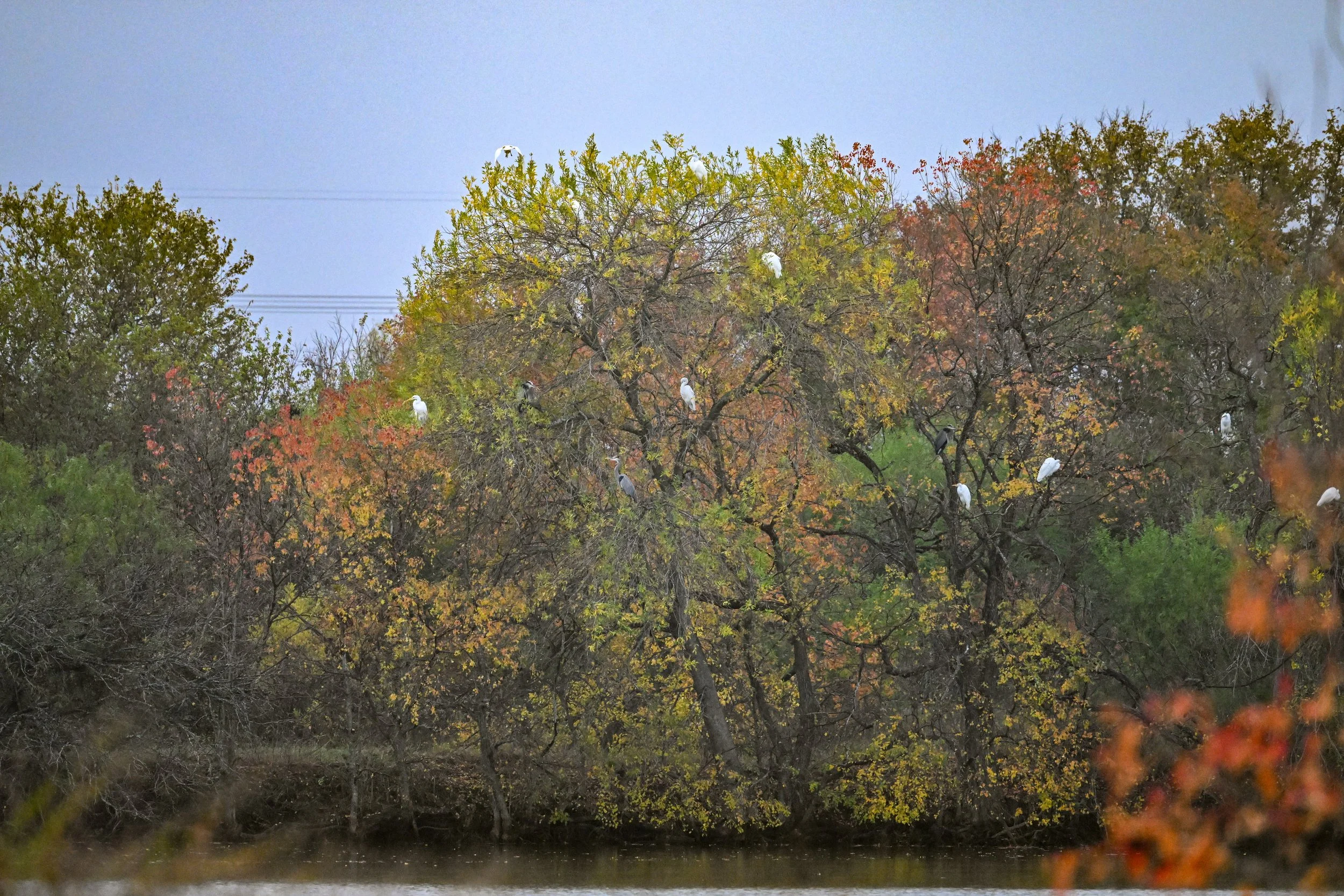
Photo courtesy Betsy Cross