Land Stewardship is for the Birds
Part 2 - What Makes Bird Habitat Good?
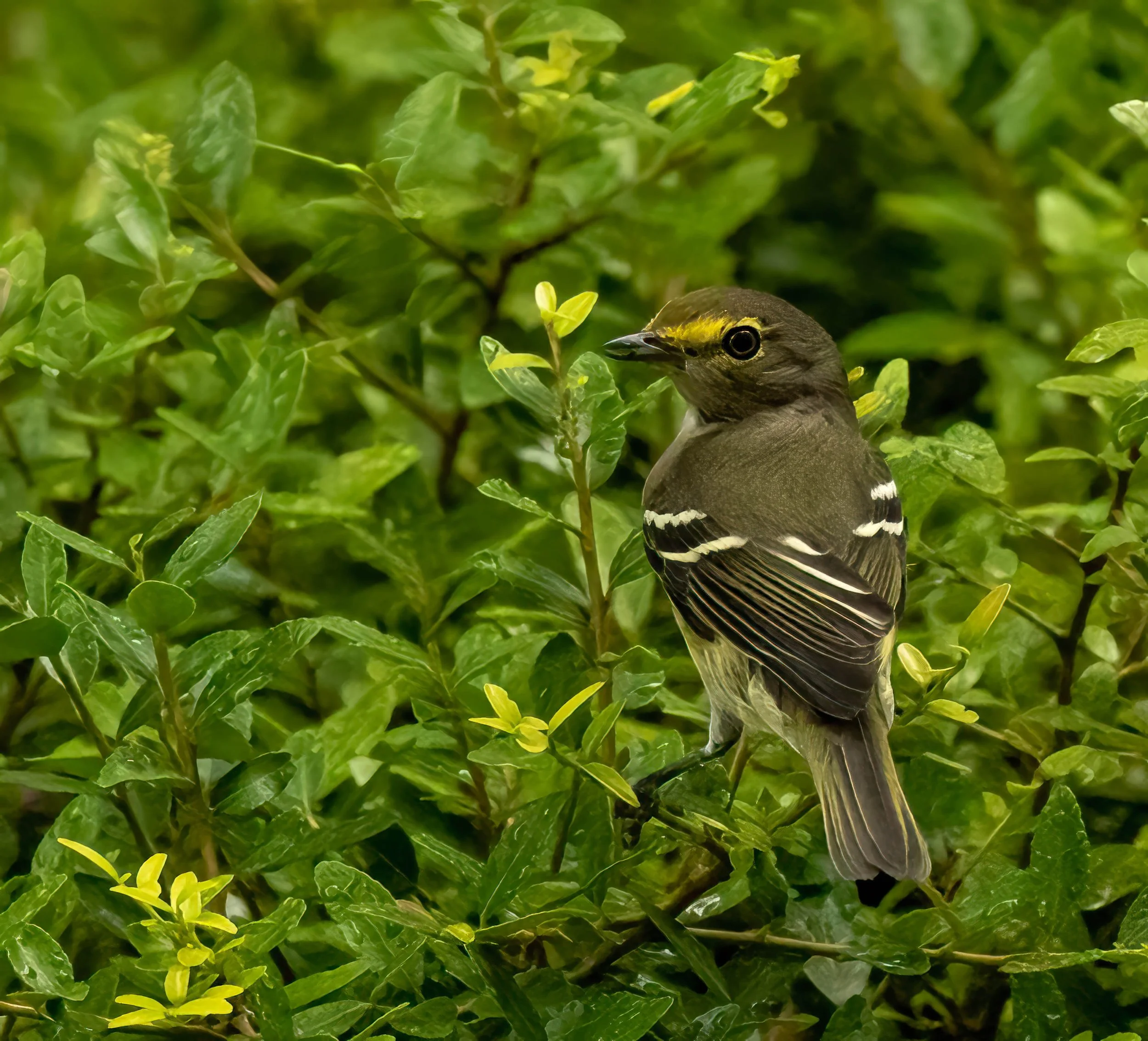
Photo courtesy Tom Hausler
“To be a good land steward for birds, you must know that all land stewardship is conducted by habitat because a bird’s habitat is where it lives - where it finds essential food, water, shelter, and space to survive.” —Rufus Stephens & Jan Wrede, Attracting Birds in the Texas Hill Country
Christine Middleton
Hays County is home to a rich diversity of bird species. Some live among us year-round. Others nest here in spring and summer. Still others come here in winter to escape colder northern climates. Then there are those who simply pass through in the spring and fall on their way to somewhere else. All have one thing in common — they require good bird habitat to survive and thrive.
What makes a habitat good for birds? There’s no easy answer—no “one size fits all.” As discussed in Land Stewardship is for the Birds: Part 1 – What Birds Need, all birds require food, water, and places to hide from predators and weather. Those who breed here in Central Texas also need safe nesting sites. From there, variations across species run the gamut from open grasslands to heavily wooded hillsides and everything in between.
According to W. Rufus Stephens, the first step in land stewardship for birds is identifying what kind of habitat your property (or a specific area of a larger property) can support. Some things are beyond a landowner’s control—climate, rainfall, base rock, past land use, etc. Other aspects may be difficult to control, particularly on smaller acreage properties—e.g., deer, the influence of neighbors’ land practices, or even what other members of the household want. But every property owner can do (and not do) things that can make life better for the birds who visit.
According to W. Rufus Stephens, the first step in land stewardship for birds is identifying what kind of habitat your property (or a specific area of a larger property) can support. Some things are beyond a landowner’s control (e.g., climate, rainfall, base rock, past land use, etc.). Other aspects may be difficult to control, particularly on smaller-acreage properties— deer, the influence of a neighbor’s land practices, or even what other members of the household want. However, every property owner can do (and not do) things that make life better for the birds who visit.
A Cautionary Tale
The Loggerhead Shrike is a relatively large songbird endemic to North America and one of only two shrike species. The bird looks somewhat like a mockingbird and has a macabre nickname—“butcher bird.” Why? This 9-inch-long carnivore sometimes catches a large vertebrate, grasping its neck in its pointed beak in a way that pinches the spinal cord, inducing paralysis. The shrike then vigorously shakes its prey. And, adding insult to injury, the bird impales its lifeless catch on a sharp object—a thorn, a twig, or even barbed wire. Interestingly, males will leave the food there, creating a “pantry” to show a potential mate they are good providers.
The Loggerhead Shrike is a relatively large songbird endemic to North America and one of only two shrike species native to North America. The bird looks somewhat like a mockingbird and has a macabre nickname—“butcher bird.” Why? This 9-inch-long carnivore sometimes catches a large vertebrate, grasping the neck of its prey in its pointed beak in a way that pinches the spinal cord, inducing paralysis. The shrike then vigorously shakes its victim. Adding insult to injury, the bird impales its lifeless catch on a sharp object—a thorn, a twig, or even barbed wire. Interestingly, males will leave the food there as part of a “pantry” designed to demonstrate to a potential mate that they are good providers.
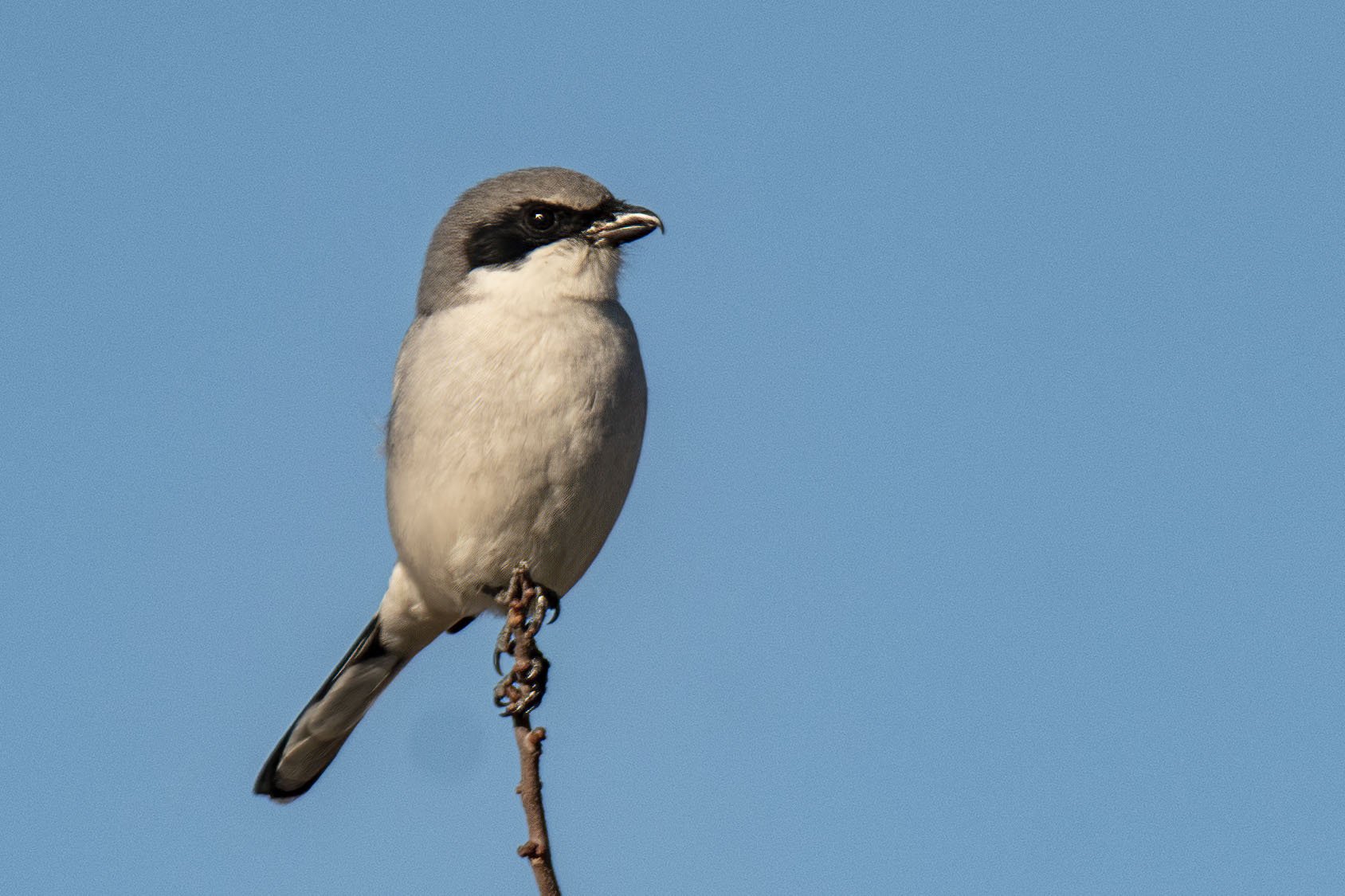
Loggerhead Shrikes are often compared to raptors although, lacking talons, their killing methods differ. But their hunting strategies are very similar to those of other raptors. Like eagles, hawks, and falcons, shrikes sit on an elevated perch and scan the ground for prey. Upon spotting a good meal, the predator will then pounce. In the breeding season, Loggerhead Shrikes rely on insects like grasshoppers and beetles, as well as small rodents. In winter, their prey might include other small vertebrates such as lizards, snakes, frogs, turtles, and, unfortunately, the occasional goldfinch or even an unsuspecting cardinal. Photo courtesy Mike Davis
So what kind of habitat do Loggerhead Shrikes inhabit? Basically, these birds prefer open places with short vegetation dotted with scattered, thorny shrubs, trees, and perhaps a few fences—and definitely thorny natives we humans prefer to stay away from, like Mesquite (Prosopis glandulosa) and Prickly Pear Cactus (Opuntia engelmannii).
Loggerhead Shrike populations have declined by roughly 75% since 1966, and the species has largely disappeared from the Northeastern United States. Texas now supports a significant portion of the remaining population and has one of the only fairly stable populations. One factor is pesticides and herbicides, which accumulate in their food chain, sometimes causing deformed beaks. Another major one driving their precipitous decline is habitat loss due to both intensive agriculture and urban sprawl.
Thinking Like a Bird
After considering what kind of habitat your property is capable of supporting, the next step, according to Stephens, is to select 2–3 “target” bird species. He cautions that the chosen species need to be as different from each other as possible. So don’t select three species of wrens whose needs would be too similar. Perhaps a more diverse group would include a hummingbird, a chickadee, and a roadrunner.
Some birds are very picky about where they choose to raise their young. The classic example is the endangered Golden-cheeked Warbler, which breeds only in Central Texas. These warblers are very selective about where they build their nests — basically moist, mixed wooded slopes with dense foliage in the upper canopy. They like places with a mix of tree ages and a moderate to high density of older trees. In particular, they need old-growth cedar, whose peeling bark they use to line their nests.
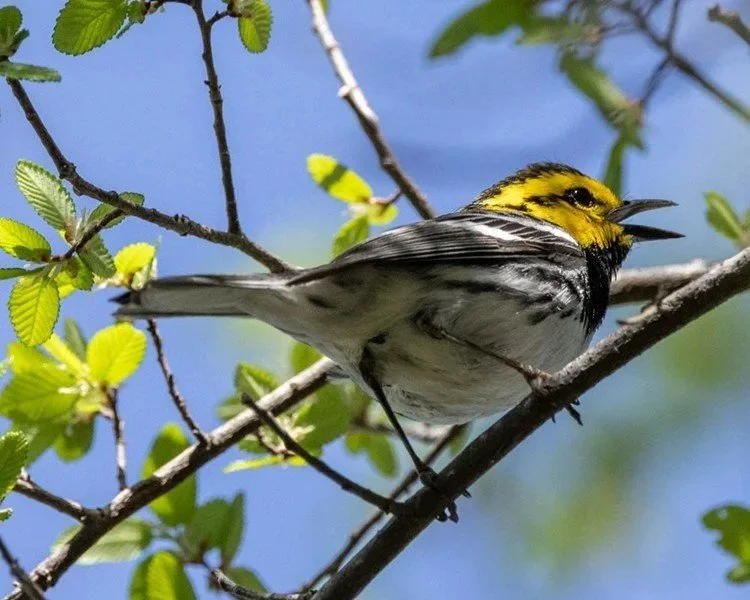
Golden-cheeked Warbler (Male) Photo courtesy Tom Hausler
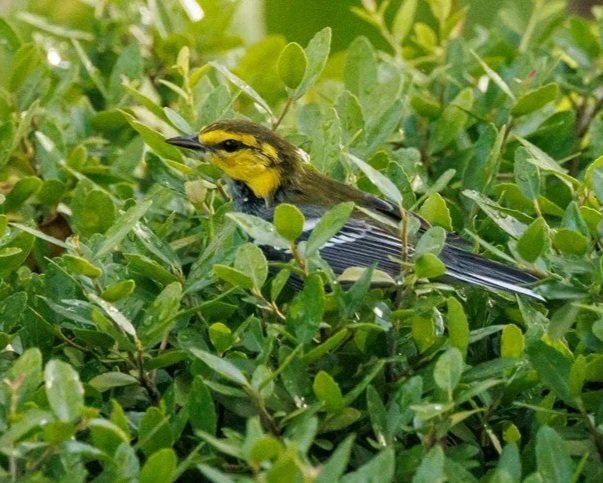
Golden-cheeked Warbler (Female) Photo courtesy Tom Hausler
Another Central Texas breeding bird, the Black-capped Vireo, is no longer considered endangered, but its fate is still tenuous due to habitat loss. Black-capped Vireos inhabit open woodlands and shrublands—open areas dotted with oak mottes that provide lots of space for hunting insects, combined with understory where nests can be hidden from predators. In particular, these birds are very vulnerable to nest parasitism by Brown-headed Cowbirds.
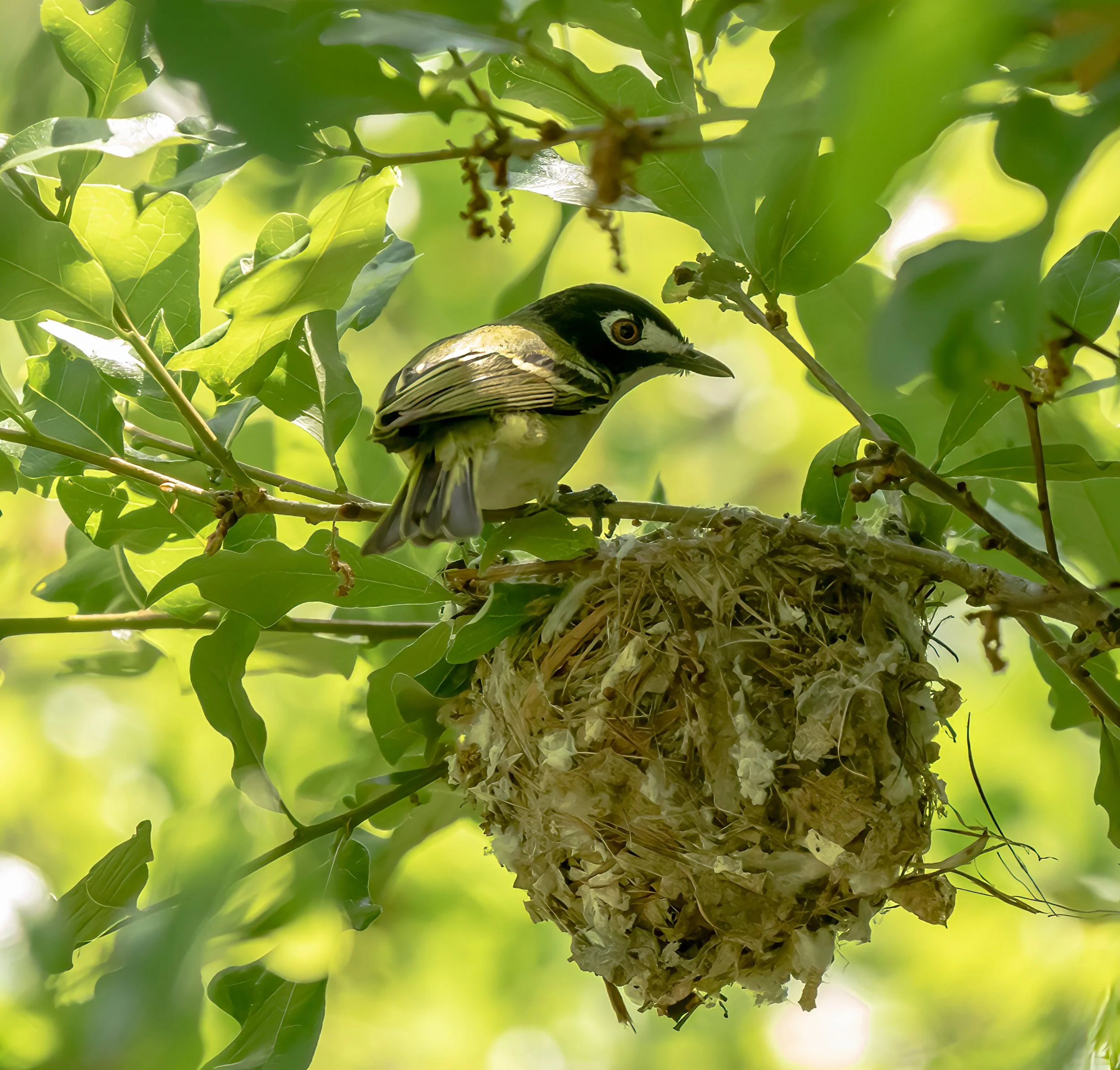
Black-capped Vireo Photo courtesy Tom Hausler
Not all birds are quite as threatened, but they too often have very specific preferences in terms of habitat in which to find food and safe nesting sites. For example, Eastern Bluebirds depend on open grasslands with scattered trees, sparse ground cover, and low perches from which to scan for insects. Bluebirds are cavity nesters, so they are also looking for places with holes in dead or dying trees.
Other cavity nesters looking for these same holes include the Black-crested Titmouse and the Carolina Chickadee. However, titmice and chickadees prefer woodlands and tree-rich backyards as hunting grounds. Besides the seeds in your bird feeder, titmice and chickadees also eat insects, spiders, and fruit. Did you know ragweed and poison ivy are important winter food sources for chickadees and other winter residents?
PLACEHOLDER FOR BLUEBIRD, TITMOUSE, CHICKADEE
Hummingbirds need more than just the sugar water people put out for them. These tiny creatures rely on the natural sugar found in nectar contained in flowering native plants. Hummingbirds also eat spiders and tiny insects (e.g., gnats, aphids, mosquitoes). The two most common hummingbirds found in the Texas Hill Country are the Ruby-throated and Black-chinned hummingbirds. Ruby-throated hummingbirds visit in the spring and fall on their way to and from their breeding areas in Central America. The only ones to breed in our area are Black-chinned hummingbirds. Their nests are constructed using lichen, spider webs, and plant down in a way that enables the nest to expand as the nestlings grow.
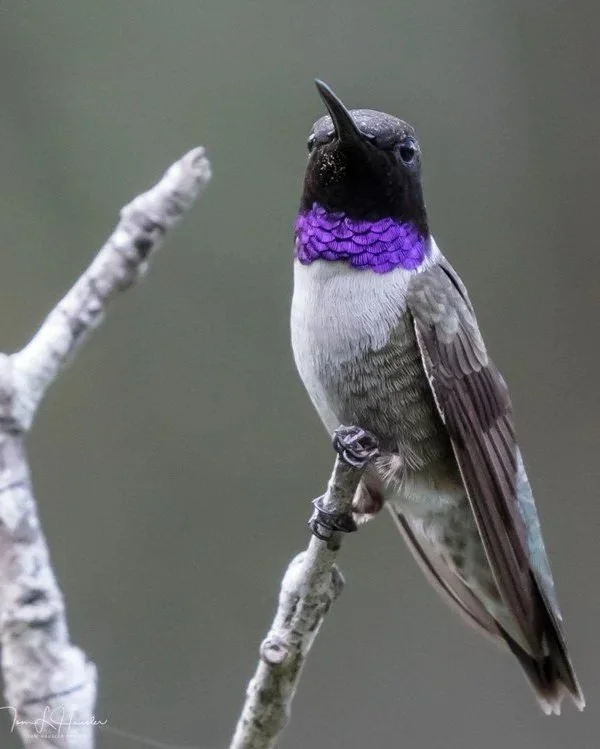
Black-chinned Hummingbird Photo courtesy Tom Hausler
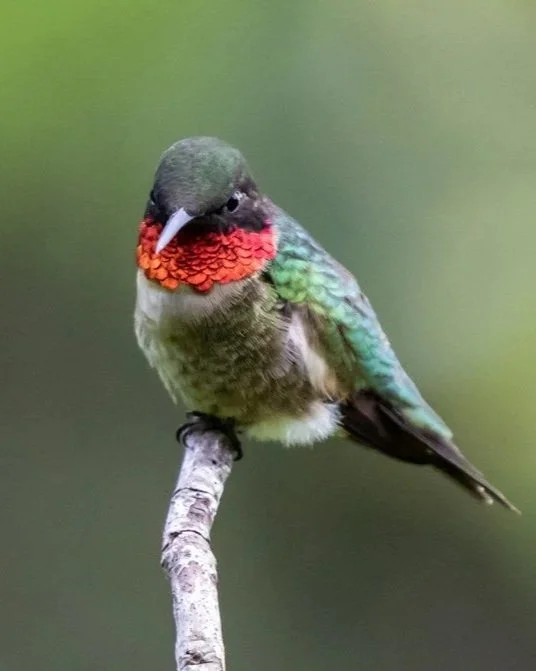
Ruby-throated Hummingbird Photo courtesy Tom Hausler
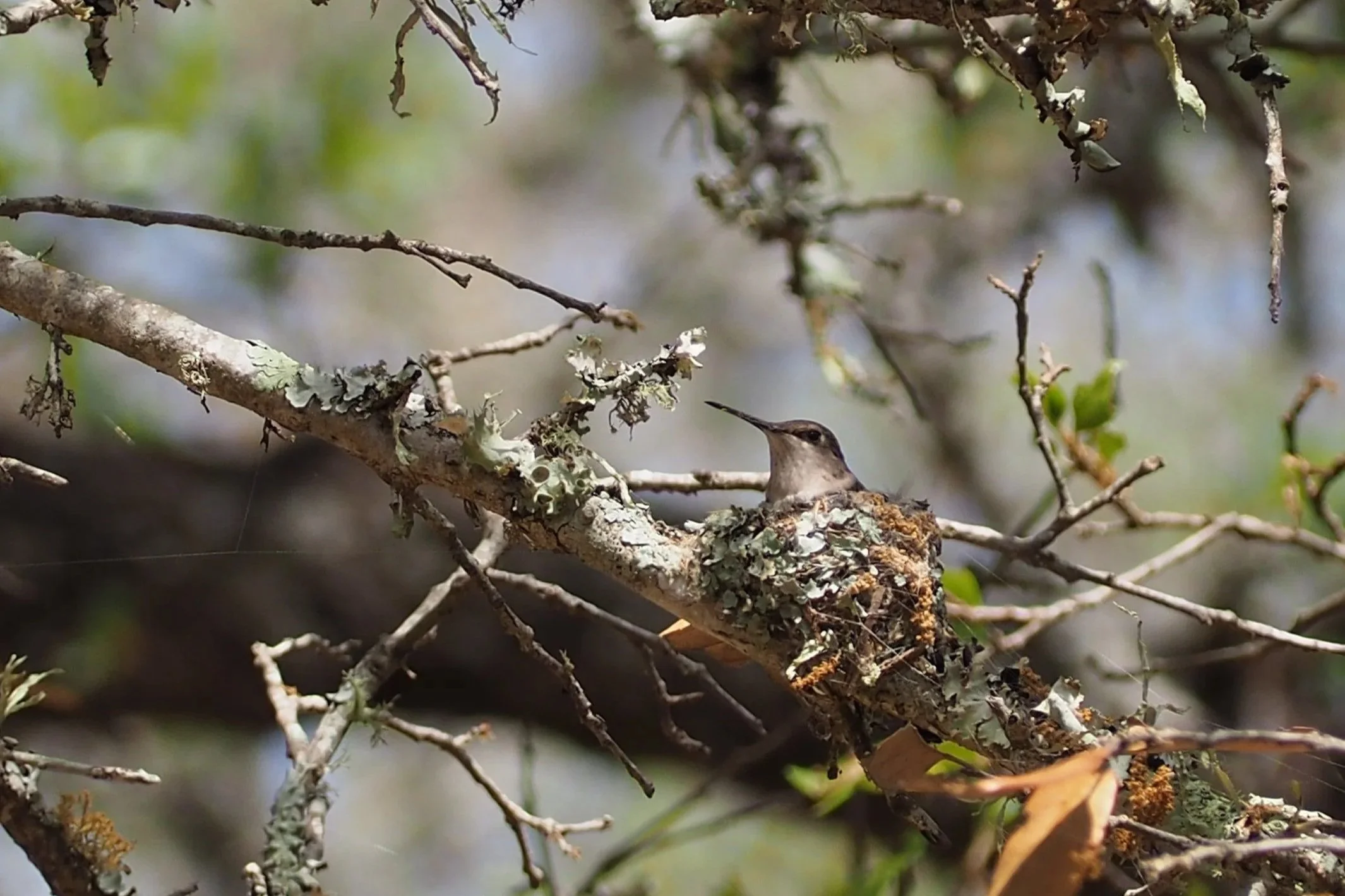
Female Black-chinned Hummingbird on the nest Photo courtesy Doray Lendacky
And what about a perennial favorite, the Greater Roadrunner! Roadrunners don’t eat plants. However, their prey—insects, lizards, snakes, and small mammals/birds—rely on the availability of native plants. And while roadrunners hunt in open spaces, their nests are found hidden in compact, low-growing shrubs. Here in Central Texas, that often means the low-growing limbs of secondary-growth, bushy cedars.
PLACEHOLDER FOR ROAD RUNNER
Mowing Is Bird-Unfriendly
Frequently mown areas are often monocultures, usually either non-native turf grass or KR bluestem. That means such areas are food deserts for most bird species—few seeds or insects. Understandably, some areas need to be mown on a regular basis. But consider how much of your property really needs to be maintained in that way. And think about how much time and money you might save!
Live on a small lot? Consider converting a portion of what is now turf grass to a pollinator garden. Then fill that garden with a diverse mix of native grasses and flowering plants. Include flowering plants that produce nectar for hummingbirds, ones that serve as host plants for caterpillars, and others that produce lots of seeds or berries at varying times of the year. And resist deadheading, a practice that suppresses seed production. Here’s a link to great advice from the Native Plant Society of Texas on how to start a native garden.
PLACEHOLDER FOR PLANT HOSTNG A CATERPILLAR
If your house sits on more acreage, definitely continue Firewise mowing around your home and other structures. And certainly mow fixed paths that enable easier access to other parts of your property. If you currently keep more than that in a perpetually manicured state, ask yourself how much of that area you and your family actually use. Or could such open areas be converted into wildflower meadows, thus creating better bird habitat? Here’s a link to a very informative Lady Bird Johnson Wildflower Center article on how to plant a wildflower meadow.
Native grasses evolved with fire and, thus, benefit from occasional disturbance. But, for most smaller landowners, prescribed burns are just not feasible. Mowing a native grass meadow in November every three to six years and at a height no lower than six inches can help mimic this natural process. For more on maintaining native grasslands, see Appreciating Native Grasslands, Part 2 - Learning to Manage Them.
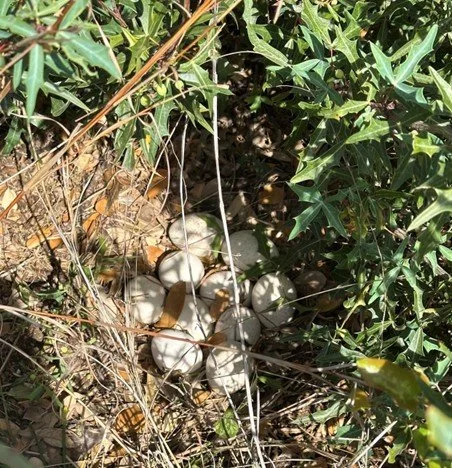
Consider Shelter and Nesting Sites
Besides food, think about shelter. On a small property, there may not be room for lots of towering trees. But don’t just think in terms of low growing plants. Just a few well-placed shrubs can provide much-needed protection from both weather and predators. Consider shrubs that produce berries, thus sustaining many of our favorite birds through hard winter months. Native shrubs are definitely better and some non-natives are detrimental. One to definitely avoid is Nandina, whose berries contain cyanide and are thus poisonous to birds that consume them.
Rio Grande Wild Turkey nest and eggs are carefully hidden under an Agarita bush. Photo courtesy_________
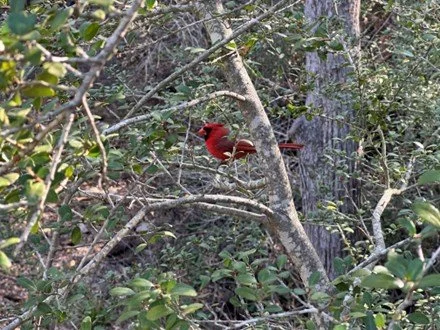
Larger properties often have areas that are naturally either wooded or grassland savannas dotted with oak mottes. Understory offers both protection and nesting sites for birds who place their nests between the ground and the canopy. Thickets with lots of nasty shrubs and vines provide great nesting sites as well as food and protection from predators. So don’t be so eager to “clean out” such thickets. It’s a lot less work, and the birds will thank you.
A cardinal forages in a natural thicket. Photo courtesy __________
That’s not to say there might not be places that should be cleared—places where woody encroachment needs to be controlled. Rather than creating a mass eviction, consider a slower, more thoughtful approach. Instead of clearing the entire area in one fell swoop, focus on just a portion, providing time for the current inhabitants to adapt. Don’t forget to leave pockets of thick brush and trees, as even grassland birds need such places dotting their habitat. And please don’t “lollypop” Ash Juniper, whose lower branches provide much-needed protection and nesting sites.
Other Bird-Friendly Suggestions
Whether you live on a small lot or own lots of acreage, if you want to attract birds, a diversity of vegetation matters. A good place to start is to think of your property as a bird feeder and safe haven for your feathered friends. If you do supplement the natural food growing on your property, make sure your bird feeder is either less than three feet or more than 10 feet from any windows. At less than three feet, a bird hitting the window hasn’t gained enough speed to break its neck. At more than 10 feet, there’s a good chance it will have enough time to change course before hitting the glass.
As you “clean up” your property, consider a bird’s perspective on the value of dead trees and downed wood. Woodpeckers love dead trees, and lots of birds use the holes they create as secondary nesting sites. So, as long as it isn’t a safety hazard, consider leaving that drought-stricken tree standing. And, given the declining population of woodpeckers, consider adding nest boxes to appropriate locations on your property.
PLACEHOLDER FOR BIRD AT ENTRANCE TO NESTBOX
And what about those branches, whether downed by a windstorm or the result of clearing efforts? Instead of burning them, repurpose them in bird-friendly ways. Why not build a brush pile in a place where woody cover is limited? Or use such branches to construct a deer exclosure—a circle of brush piled high and wide enough to exclude deer. That’s a good way to encourage native plant species, particularly those vulnerable to deer herbivory, thus increasing the diversity of food available to your avian visitors.
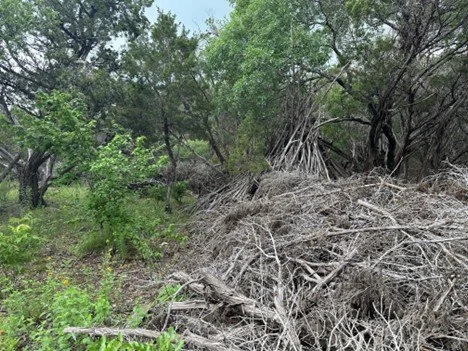
A deer exclosure can be created by piling brnaches in a circle high and wide enough that deer can’t enter. Photo courtesy _______
And always, especially in freshly cleared areas, be on the lookout for invasive trees, grasses, and forbs. Some birds may eat the seeds of such plants. But seeds often survive ingestion, resulting in the spread of the invasive species to new areas. And all such invasive plants crowd out natives that are better able to satisfy the nutritional needs of birds that have evolved along with them.
One final plea: to the greatest extent possible, avoid using pesticides and herbicides. Not only can pesticide-coated seeds kill birds, exposure can result in reproductive failure—thin eggshells, reduced hatching success, or impaired parental care. Other impairments (reduced ability to forage, fly properly, navigate during migration, etc.) can also result from the direct or indirect accumulation of toxic chemicals. And both pesticide and herbicide use reduce the food supply by killing insects and lowering plant diversity.
So examine whether what you are doing provides more or less food and safety for the birds you want to attract. Test future plans against how favorable or detrimental they are to the well-being of birds who already share your space. And always ask, “What more can I do to help make my avian friends’ lives a bit easier?”
Own acreage in Hays County? We’d love to come by and talk to you about what you might do to improve bird habitat on your property. And, while we are there, we can talk about any other concerns you may have regarding stewarding your property. As part of our HELM (Habitat Enhancing Land Management) program, we offer property visits where landowners can learn about sustainable practices designed to enhance wildlife habitats, improve soil, effectively manage invasive species, and much more!
If you would like to schedule a HELM visit, fill out this form. And please help us by spreading the word to your friends and neighbors.
The HELM Network News is a periodic feature in The Hays Humm, the online magazine of the Hays County Chapter of the Texas Master Naturalist™. You can read the latest issue and explore past articles at this link.