Seeds Know What To Do
Betsy Cross and Christine Middleton
It’s not every day that a Hays County Master Naturalist’s article reaches beyond The Hays Humm, but that’s exactly what happened following a HELM team workshop at Native American Seed (NAS) last September.
A Visit to Native American Seed
Christine Middleton
The HELM team’s trip to Native American Seed’s farm in Junction, Texas was truly special. After our two-plus-hour drive, we gathered outside, where company founder Bill Neiman rode down on his bike to meet us. He greeted me with a big hug and spoke at length to our team about the history of the seed company and its mission.
When it was suggested that someone from the HELM team write an article for The Hays Humm, Kiran Topiwala quickly raised his hand. As one of our newest team members, we were just getting to know him. Little did we realize we had such a talented writer among us. Emily Neiman, Bill’s daughter, asked that we share the article with her after it was published.
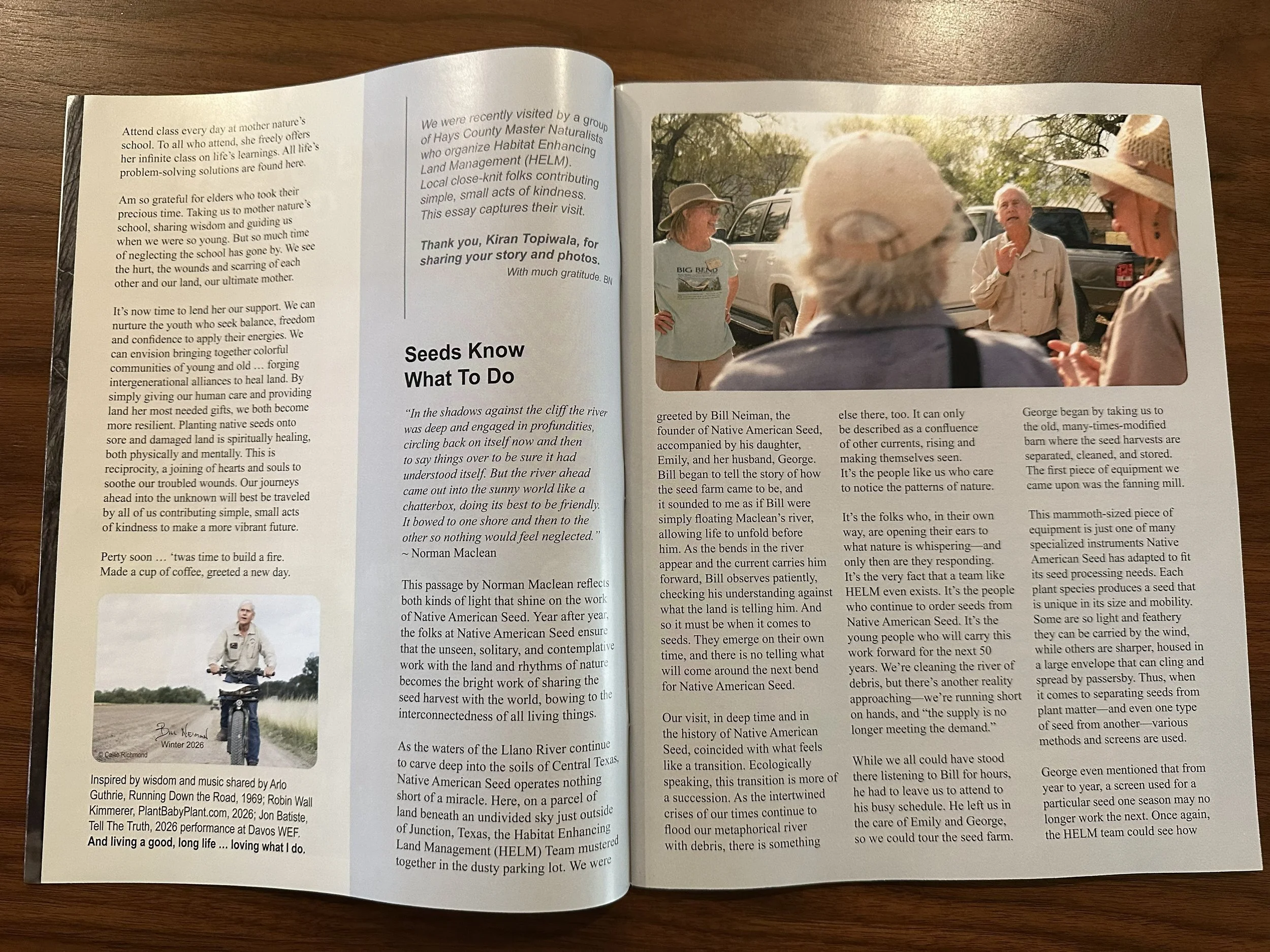
If you haven’t read Kiran Topiwala’s article, Seeds Know What To Do in the November Hays Humm, I hope you will. What a thrill it was to learn that Native American Seed chose to include Kiran’s piece in their most recent Spring 2026 catalog!
What began as a chapter story about seeds and stewardship was ultimately republished in Native American Seed’s Spring 2026 catalog—extending the reach of HELM’s work, highlighting the strength of our community partnerships, and showcasing the thoughtful writing of Master Naturalist Kiran Topiwala.
About Kiran Topiwala

Kiran Topiwala Photo courtesy Mimi Cavender
Kiran is a 2025 Graduate of the Spring HCMN Fireflies Class. When asked what drew him to the Master Naturalist program, Kiran explained, “My work centers on conservation and regeneration. I’m mostly self-taught—a student of nature—and after earning my Permaculture Design Certificate in 2023, the Master Naturalist program felt like the right next step.”
Kiran describes himself as a systems thinker and bioregional engineer whose work sits at the intersection of ecological design, community empowerment, and economic transformation. He is deeply inspired by patterns of regeneration and spends his time exploring the edges between self and story, memory and myth, individual and ecology.
As the founder and Co-director of Kula Applied Research Institute, a 501(c)(3) based in Austin, Texas, Kiran leads a research and design laboratory dedicated to restoring the relationship between water, land, and community. Rather than keeping that work behind closed doors, Kula turns its research into free, open-source toolkits and case studies—practical guides that make it easier for individuals, neighbors, and community groups to take action in their own places. He is also the owner of Nurture Nature Regenerative Landscaping LLC, which is a regenerative land management/restoration and native-focused landscaping company serving the Texas Hill Country.
Kiran holds a Master's Degree in Development Practice from Emory University, where he focused on sustainable environments and livelihoods, and a degree in Systems Engineering from Texas A&M University. This rare interdisciplinary foundation has taken him from designing clean water systems in rural Honduras to building holistic elder care networks across 800 villages in India, from dark sky conservation strategy in the Texas Hill Country to humanitarian program evaluation spanning multiple continents with CARE.
About Native American Seed
It’s likely that you’re familiar with this Texas seed company or that you’ve visited their store or even ordered from their extensive catalog. Here’s how they describe their mission and their work on their website.
Native American Seed (NAS) is a family-owned, Texas based company full of passionate employees aligned through a values-driven mission… helping people restore the earth.
Established in 1988, NAS produces, harvests, and distributes 100% native wildflower and grass seeds, while also offering ecological restoration services rooted in deep respect for the land. As awareness of native ecosystems continues to grow, demand for our high-quality prairie seeds and restoration expertise continues to expand, driven by communities, landowners, and professionals seeking lasting ecological impact.
And from Native American Seed’s Recent News: https://seedsource.com/in-the-news/:
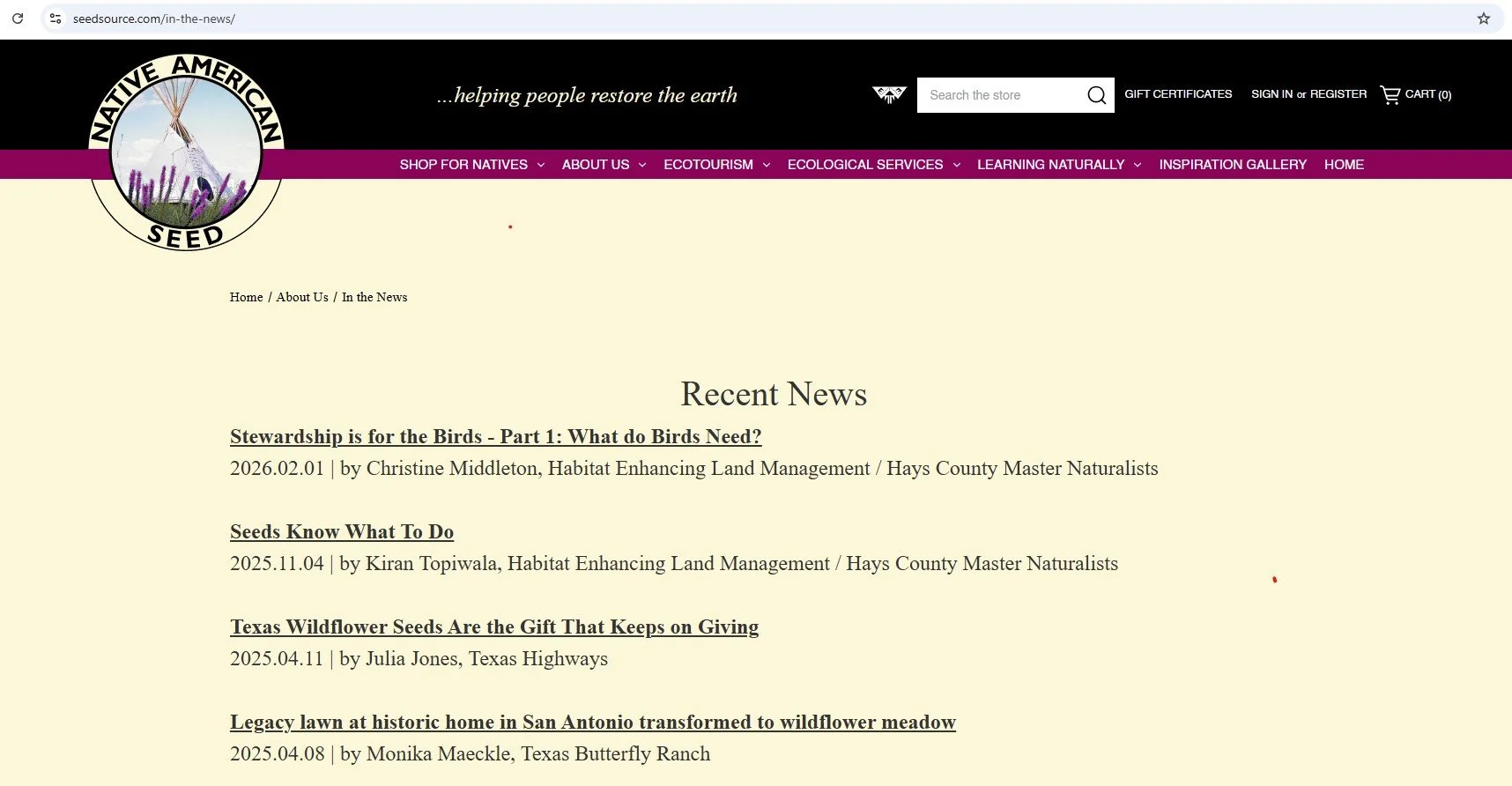
The top two links under NAS’s website of Recent News include Christine Middleton’s most recent HELM article, Stewardship is for the Birds - Part 1: What do Birds Need? and Kiran Topiwala’s article, Seeds Know What To Do, both first published in The Hays Humm.