A Reader’s Perspective
BC
Eve Stephens
If you’re a nature lover, Canyon Lake Gorge is probably a place you have visited. Located in Comal County, it sits just below the spillway of Canyon Lake. It is a place where folks take serene hikes through the Ashe junipers, listen to birds call, scramble over boulders and barren rockscapes, and enjoy sweeping vistas. However, the Gorge wasn’t always there. Mother Nature created it in 2002. That year, the rains seemed unceasing, and a torrent of rushing floodwaters ripped through the rock, trees, and soil to create the canyon that exists there today.
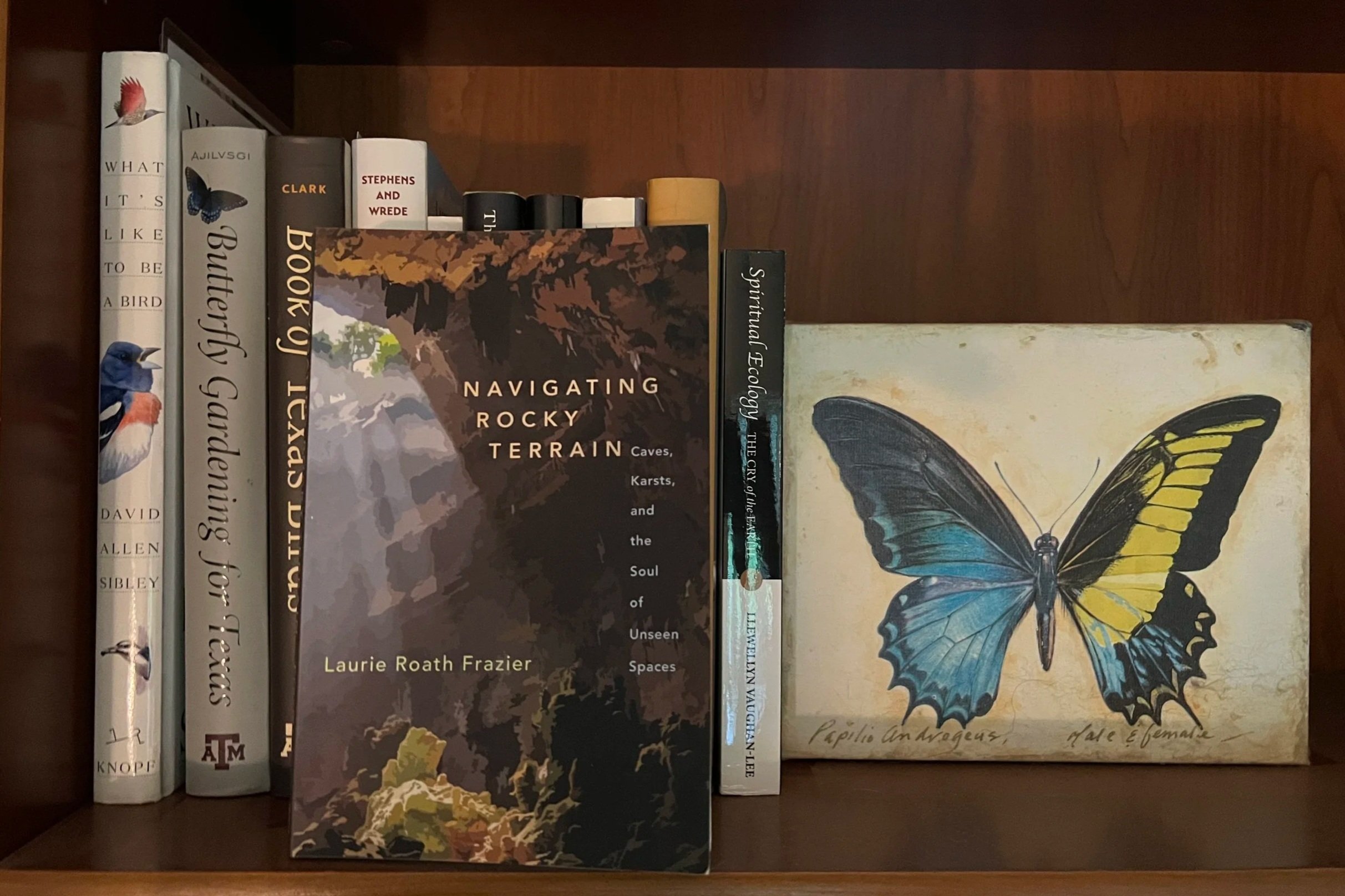
Twenty-four years later, I visited Canyon Lake Gorge for the first time as part of the Hays County Master Naturalist training class. It was May 2026. The weather was perfect, the Texas wildflowers were in bloom, a spotted sandpiper was hunting along the water’s edge, lizards scuttled at our feet, and I was with a bunch of nature nerds freaking out about rocks. Fast forward to August 2026, when Laurie Roath Frazier’s book Navigating Rocky Terrain was selected as the HCMN Book Club book of the month. I was incredibly excited because this was a book birthed by a Hays County Master Naturalist and set in many of the cool nature spots I had just visited as part of my naturalist training, including Canyon Lake Gorge.
Canyon Lake Gorge is a central character in Navigating Rocky Terrain. It makes several important appearances and sets the theme of the book. In the first chapter, Laurie’s descriptions of her hike through the Gorge brought back wistful memories of my own visit. “From the ledge, the gaping crack in the earth below is as deep as a five-story building is tall. It is vast and empty, a desert of broken rock, the bare bones of a river that winds downhill for more than a mile” (p. 5). I remembered that, but more importantly, I felt it. Navigating Rocky Terrain is the author’s exploration of nature as it parallels painful events happening in her life. Just as Canyon Lake Gorge experienced a huge disturbance and eventually recovered, she explores how we as humans can navigate the disturbances that come into our own lives.
As a Master Naturalist in the Central Texas area, I was thrilled to discover other familiar local “characters” that make appearances in the book. Because I had been to the places she described in the book, the lessons she learned and wrote about suddenly became my lessons too. Just as it was exciting to read about Canyon Lake Gorge, I was excited to read about Laurie’s experiences at Jacob’s Well, Lady Bird Johnson Wildflower Center, Enchanted Rock, Honey Creek Cave, Westcave, Bracken Cave, Bamberger Ranch, Natural Bridge Caverns, Balcones Canyonlands Preserve, Spring Lake, Ghost Note Brewing, and Roughhouse Brewing.
We all go through disturbances in our lives, whether it is the death of loved ones similar to what Laurie experienced, or just other types of hard times. As naturalists, we often go to nature for therapy, but this book is a reminder that not only can nature be therapeutic as we experience it in its current forms, but it can also serve as a model for resilience. We can use the lessons found in nature to navigate the rocky terrain in life and remind ourselves that “… a disturbance, like a fire or virus, can lead to healing” (p. 50). She says the trick “…is to accept change, however small, to sit with it, and to see what the cracks reveal” (p. 71).
At the end of August 2026, Laurie Roath Frazier was gracious enough to meet with the HCMN Book Club and engage in discussions about Navigating Rocky Terrain. I love book club meetings where the author shows up. There is something incredibly intimate and personal about the experience. We met in the upstairs loft of Roughhouse Brewing, the same place where she said she spent many days working on her book. From Laurie, we got to hear how her book was published, the backstories of some of the things that happened in the book, how her rewilding project was going on her property in Blanco (slowly!), and how her book has been used in curricula at Texas State University.
In addition to sharing how she learned to navigate the disturbances in her life using nature as a model, Laurie read a passage from the book. It was a bit of shared wisdom she learned from authors Robin Wall Kimmerer and Paula Gunn Allen. As she writes in her book, this bit of wisdom became a shift in her purpose. It was a reimagining of how disturbances play a role in life. Not only did she learn how to navigate rough times, but she learned to frame it as part of the evolution we go through as human beings, naturally moving from one role to another. Disturbances are neither good nor bad. They just are.
“As a woman passes through the phases of life, her role changes—daughter, explorer of self, friend, wife or partner, perhaps mother. Eventually her circle expands outside of herself and her family. Her experience and knowledge grow, and she is called to tend to the well-being of the larger human community. Teacher. Role Model. Keeper of stories and wisdom. And, as time passes and her circle continues to widen, something beyond the human community beckons. In the final phase, she embraces the whole planet and begins her work mothering the earth” (pp. 147-148).
As we move into the quieter months of winter, we might not be outside as much as our naturalist souls want to be. This is your chance to sit down and read Navigating Rocky Terrain by fellow Hays County Master Naturalist Laurie Roath Frazier. As you read, you’ll remember all your favorite places to visit. If you haven’t been to some of the places mentioned, you’ll add them to your list of places you want to visit. If you haven’t been to Canyon Lake Gorge yet, you’ll go soon. And if you have been, you’ll remember the first time you saw it and how it made you feel. But whether you’ve already been there or have yet to visit, you may discover a lesson in “…a deep understanding of life’s cycles, of when to shelter and when to emerge” (p. 186).