Escarpment Black Cherry
Our Rare and Special Endemic
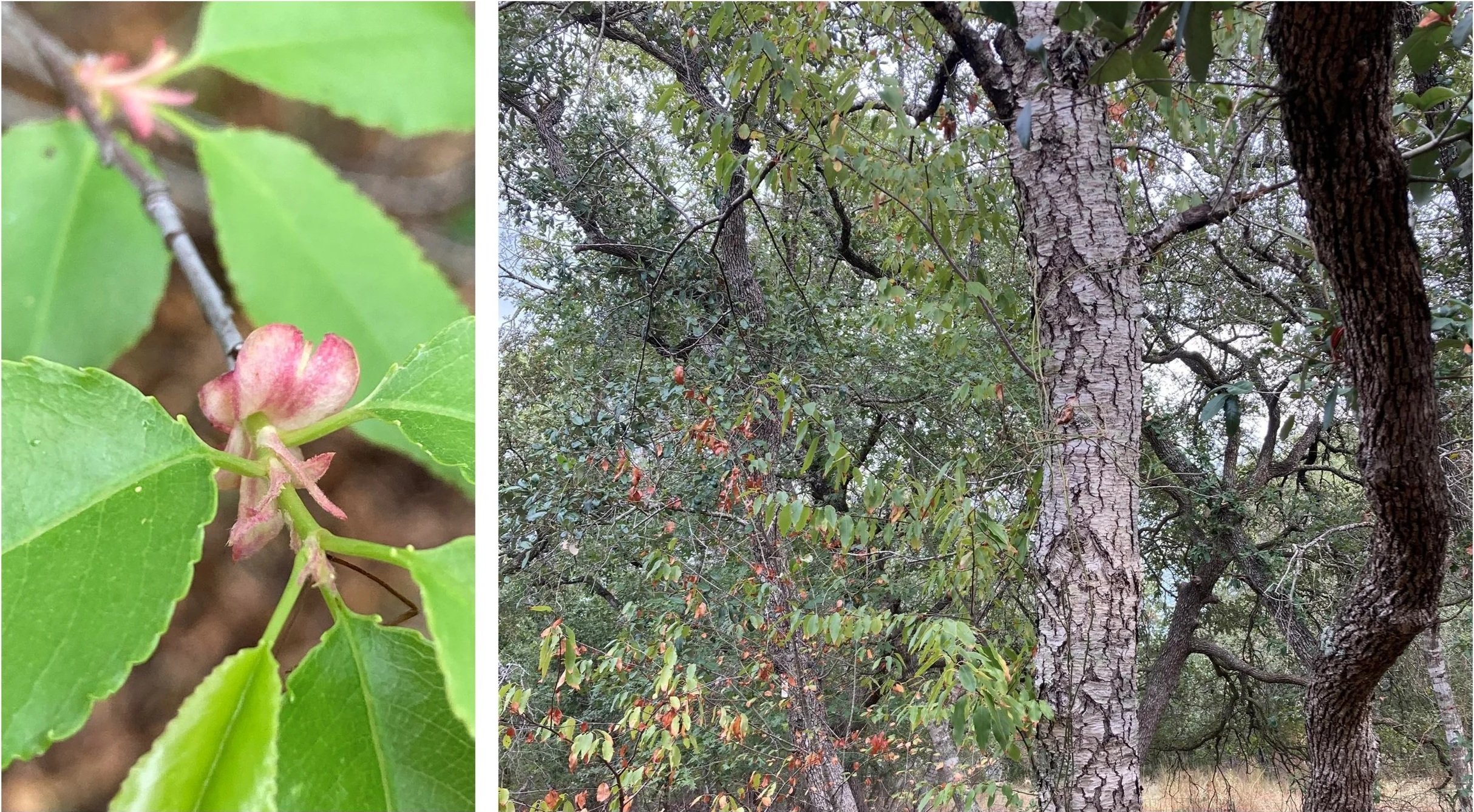
Photos courtesy Dell Hood
Dell Hood
Cherry trees are native to temperate woodlands across the Northern Hemisphere, with several species widely spread on a continental scale. Some cherries, however, have small and limited ranges. In the Texas Hill Country, we are endowed with one that has been acknowledged as special in its very name and was not definitively described until the middle of the 20th century.
Tree cover of the Edwards Plateau is often described as dominated by the few trees familiar to us—our own live and red oak species, junipers, and cedar elms. Under their canopies, we may recognize Texas persimmon, buckeyes, and a few other understory trees and shrubs. If we focus on these familiar species in our woodlands, we miss one that is unique to our area and may be the most attractive one in the canopy. On the rocky and thin soils of the southern Edwards Plateau, it can often emerge as a canopy tree, reaching 45–50 feet with its top above shorter oaks and junipers. This is the rarely seen and hard-to-find Escarpment Black cherry (EBC), Prunus serotina var. eximia.
Include a Heading Here?
Fifty years ago, we were fortunate to buy two separate properties near Wimberley, both of which had recently been subdivided from ranchland and had some mixed woody species remaining; together they totaled fifteen acres. It was several years before I was able to identify trees, and I was pleasantly surprised when I found a lone Escarpment Black Cherry on one and a small stand of six to eight young ones surrounded by junipers on the other. Among several hundred live and red oaks, junipers, and cedar elms, there were fewer than ten cherries, all of which were young stems ten to twelve feet tall.
All true cherry trees are in the botanical genus Prunus, together with the other stone fruits—peaches, plums, and apricots. Worldwide, the Prunus genus has 300 to 400 species, subspecies, and varieties (depending on who’s counting), and a few of them were among the first tree crops to be domesticated and bred for fruit production. Taxonomists created a subgenus, Cerasus, with approximately one hundred species exclusively for the cherries, but this name is rarely used in botanical citations. A few of these species are important for their wood or fruit or as landscaping trees. What would take the place of the sweet cherry in modern courtship or the striking blooms in spring of the Japanese cherries lining the Ellipse in Washington, D.C.?
Prunus serotina was described botanically by Friedrich Ehrhart, a German botanist and student of the Swedish taxonomist Linnaeus, in the last half of the 18th century. The name Prunus derives from the Latin name for a plum; serotina means late-blooming, for the leaves have almost completed their development before the flowers bloom.
The most widely distributed cherry in the U.S. is Prunus serotina, with the common names American, Black, or Eastern cherry. Its native range is wide, from the Atlantic coast westward to the forests of East Texas; these are Prunus serotina var. serotina.
West of the gap created by the Blackland Prairie, there are separate, distinct populations in the woodlands of the Edwards Plateau, the Trans-Pecos mountains, and west to southern New Mexico. Within this expanse, several varieties have been identified, based on differences in the floral parts, leaves, height of the mature trees, and the soil and climatic conditions in which they thrive.
What makes our Escarpment endemic tree stand out is the variety name eximia, the feminine adjective form of a Latin root meaning choice, selected, excepted, excellent. It was not accepted as the Linnaean standard for our tree until 1951, when Rogers McVaugh, an American botany professor at the University of Michigan, published research on black cherry species native to the southwestern U.S. and Mexico. Its range is limited to the twenty or so counties that define the southern and southwestern margins of the Edwards Plateau. In physical characteristics, it differs from the eastern cherries by the absence of fine hairs on the undersides of its leaves and by having a longer leaf petiole. Additionally, it is adapted to the thin alkaline soils and lower rainfall of this range, while its eastern relatives thrive in deeper acidic soils better watered by regular precipitation. Before McVaugh’s work, there was debate about whether eximia described a species, subspecies, or variety. As the techniques of molecular-level research advance, the criteria for distinctiveness become ever finer and more subjective, and some former names for EBC remain in use.
Another Heading Here?
For the first decade or more of their lives, the trunks of EBC trees have a very thin, pale gray, sometimes greenish-brown bark marked by distinct horizontal lines of lenticels, which are small breathing pores.
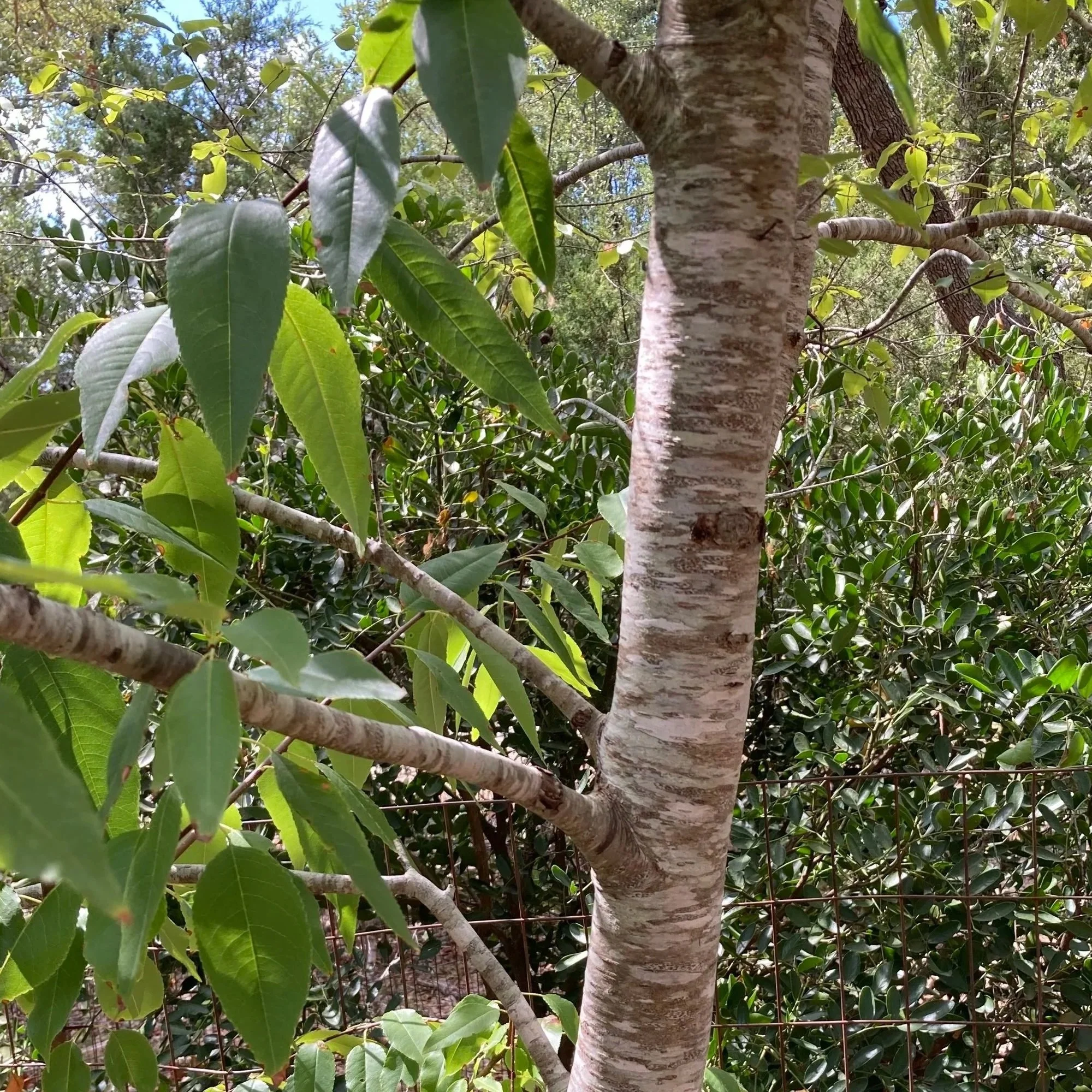
Escarpment Black Cherry, approximately 15 years old
As they mature, the bark becomes thicker, the lenticels disappear, and the bark forms vertical lines that give it a scaly appearance; it may sometimes naturally shed pieces.
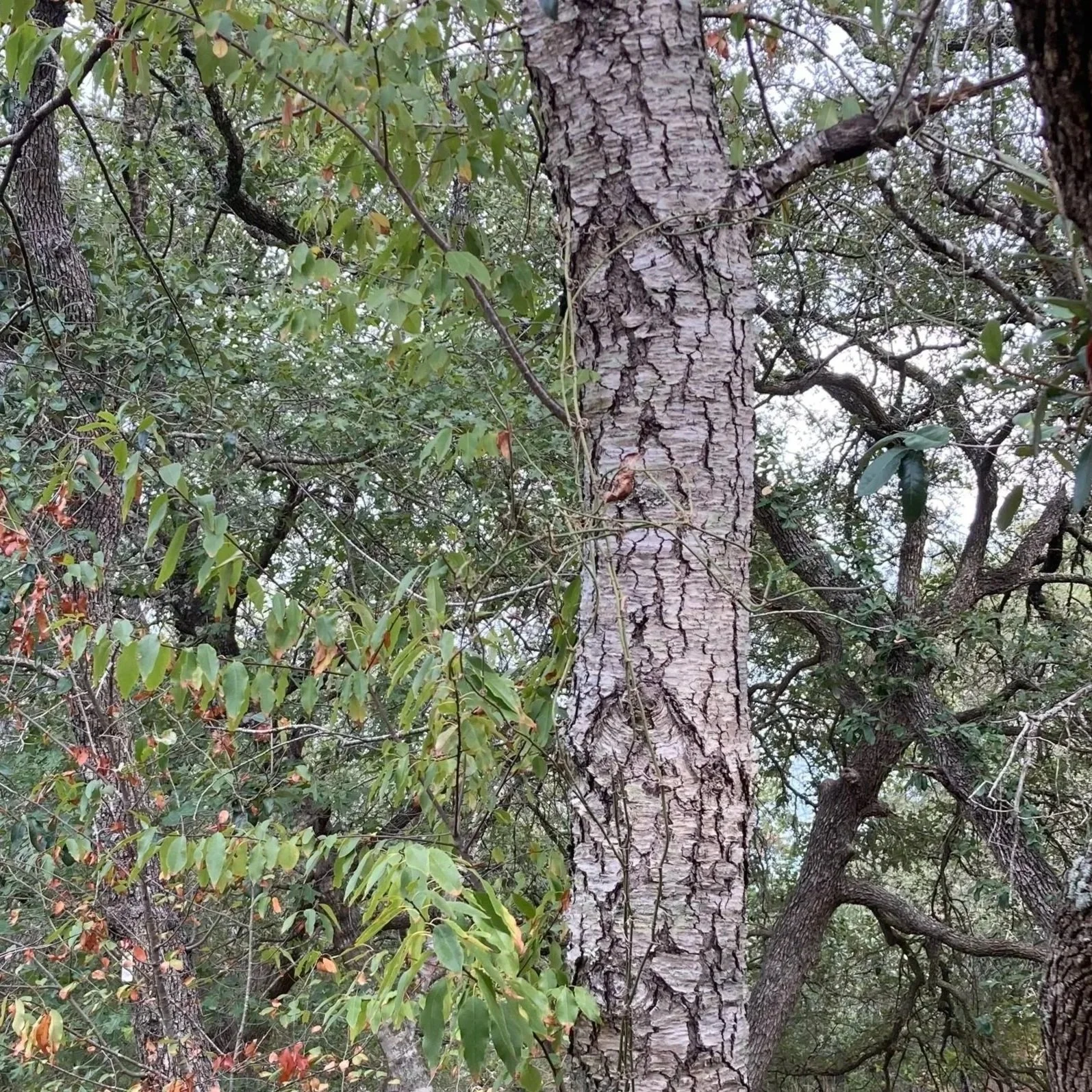
Mature Escarpment Black Cherry, about 40 years old
Cherry seeds require a long period of ripening in leaf litter followed by a winter of cold stratification to sprout, a process that usually takes two to three years. After sprouting, growth can be rapid if all required factors are optimal—soil and air temperatures, precipitation, and the ratio of sunlight to shade, which the seedlings prefer until they are well established.
Cherry wood has long been one of the most desirable woods for many domestic uses, including flooring, cabinetry, decorative pieces, tool handles, and numerous others. The inner bark was used medicinally by many Native American groups to treat coughs, digestive system ailments including intestinal worms, burns, and other skin conditions. The fruit was eaten raw and dried for use as pemmican or brewed as a tea. The Delaware tribe along the middle Atlantic coast made a cough syrup from the fruit, a practice quickly learned and adopted by European settlers. The black cherry is recognized as a valuable wildlife plant as well. Dr. Doug Tallamy, a professor in the Department of Entomology and Wildlife Ecology at the University of Delaware, ranks black cherry and other species of the genus Prunus as his second-highest-rated food plants for wildlife (oaks are first). Other biologists have the black cherry second on their list of favorite fruit trees in the forests of eastern North America.
All parts of all Prunus trees except the fruit contain poisonous compounds fatal to humans and mammals if ingested. The bark, twigs, leaves, and hard seeds (fruit pits) produce toxic glycosides, amygdalin, and prussic acid.
If you are caring for land with any stands of trees, you may have the opportunity to make a meaningful contribution to the preservation of one of our state’s rare botanical treasures, the Escarpment Black Cherry. Learn to recognize this tree in all seasons—its leaves, trunk and bark pattern, and the beautiful spring flowers that call out to be seen and admired. Protect the trunk from damage by bucks that rub velvet off their antlers, destroying the vital cambium growth tissue; protect young saplings from all browsers; if getting occasional water to them during an extended dry spell is doable, make the effort. EBC trees adapted over hundreds of millennia to prefer a certain range of below-freezing air and soil temperatures for seeds to sprout, followed by a regime of precipitation and temperatures alternating within extremes that occurred on a time scale to which their genetic material was accustomed.
With EBC population density as low as records and experience indicate, and with the unrelenting clearing of woodlands for development accompanied by increasing stresses of localized warming and disruption of historic rainfall patterns, ensuring the survival of every tree should be a commitment of passion and resolve for all lovers of our unmatched botanical inheritance. If you are fortunate to have EBC, you have the rare, special opportunity to be responsible for a native tree’s continued existence as climate changes challenge this beautiful tree.
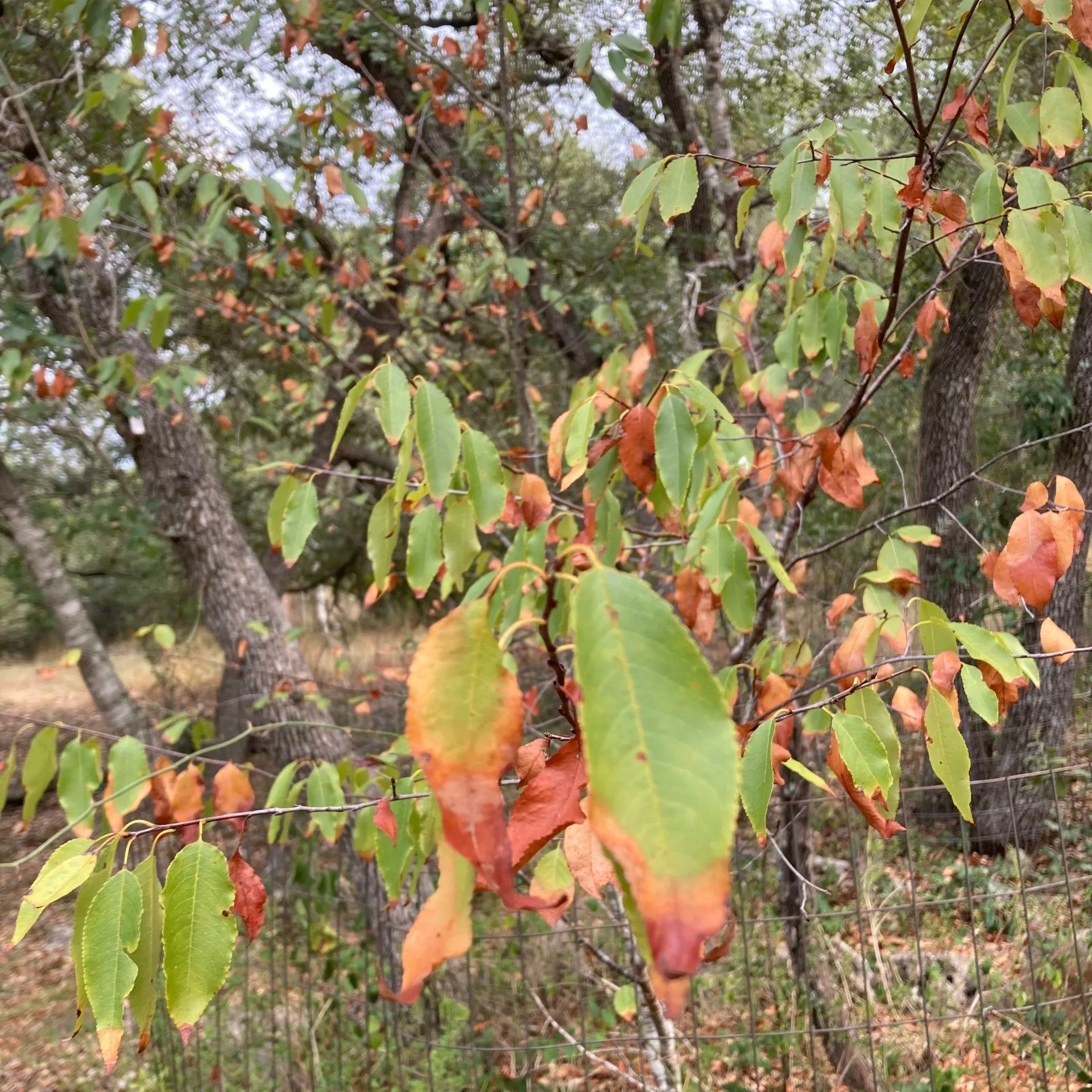
Recognizing an EBC on the Edwards Plateau is not that challenging.
The mature trunk is straight, with pale whitish-gray bark with long vertical darker stripes. Branches and twigs are reddish brown. The leaves have rather long stems, are lance-shaped, much longer than wide, taper to a fine point, and have saw-like edges.
In fall, they turn bright yellow and red and are easily recognized among all the browns and sepias in the leaf litter.
Become founding members of the Champions of Escarpment Black Cherry Corps!
SOURCES/BIBLIOGRAPHY
A Long Ride in Texas: The Explorations of John Leonard Riddell. Edited with an introduction by James O. Breeden. Texas A&M University Press, 1994. Episodic journal of a medical doctor, botanist, and geologist who rode from Houston to the area of the lost San Saba gold horde in 1839, traveling through the southern and western parts of the Texas Hill Country, including the upper Guadalupe River. He records numerous tree species but no cherry trees.
A Natural History of Trees of Eastern and Central America. Donald Culross Peattie. Houghton Mifflin, 1991; reprint of 1948 edition.
The Silva of North America. Vol. 4 – Rosaceae-Saxifragaceae. Charles Sprague Sargent. 1892. Accessed online via Biodiversity Heritage Library.
The Natural History of Texas. Brian R. Chapman & Eric G. Bolen. Texas A&M University Press, 2018.
The Trees of Texas. Isaac M. Lewis. University of Texas Press, 1915.
Texas Forestry Association. Texas Sustainable Forestry Initiative FECV Assessment 2026.
Lady Bird Johnson Wildflower Center native plants database.