Review: Is A River Alive?
Samantha Youngblood
When you’ve stood at the edge of Jacob’s Well, you can empathize with Robert Macfarlane. He’s a British nature writer, author of best‑selling books, and professor. Is a River Alive?, his latest book, opens with the author reflecting on the impacts of drought on a spring a mile from his home in England. “I dream often of rain; we all do,” he writes about a devastatingly dry summer. That line, and many that follow, captured a familiar feeling when you live in Central Texas: that waterways are more than water-bearing. They are places with histories, identities, and vulnerabilities.
Macfarlane structures the book around three journeys to threatened water systems. His first stop is to northern Ecuador, where he visits Los Cedros, a cloud forest under pressure from metal mining and deforestation. Next, he travels to Chennai, India, to witness the decline of the Adyar River. The final leg takes him to remote Canada, where he paddles the Mutehekau Shipu, the Innu name for the Magpie River. Throughout these travels, he tags along with local activists, scientists, and Indigenous leaders, returning again and again to the central question of the book. The answer he arrives at is layered and complicated.
The book blends philosophy, cultural history, and political commentary. It’s nature writing, but not in a scientific sense. I consider it more a travel journal, with poems, song lyrics, and literary references dusted throughout. The glossary, index, and bibliography are delightfully extensive, but the book is not a technical guide. Readers whose conservation interests extend beyond hydrology will find this intriguing. Fans of Robin Wall Kimmerer will appreciate the multiple nods to her philosophies and must-read book, Braiding Sweetgrass.
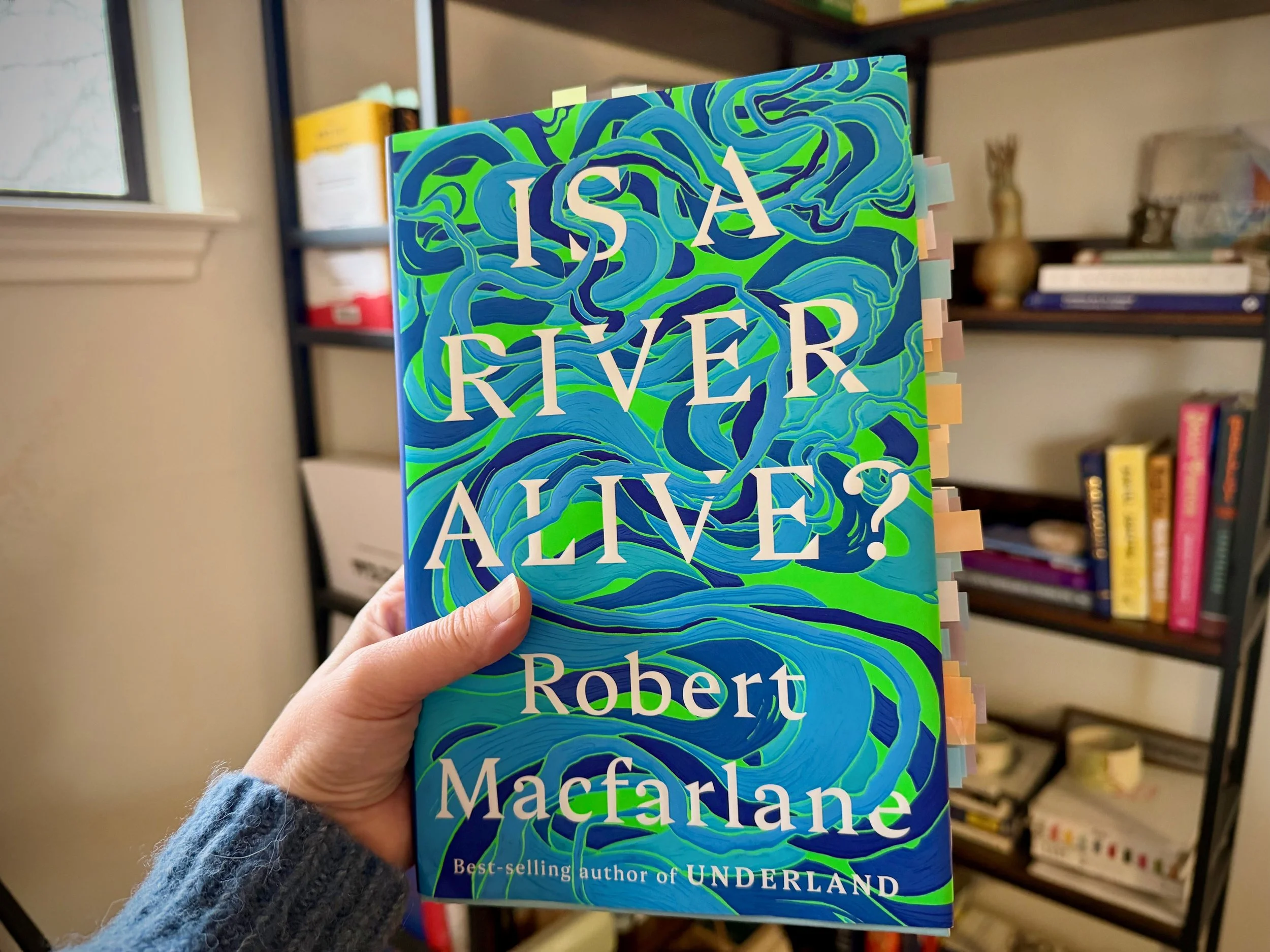
I picked up a signed copy of Is a River Alive? from a botanical garden gift shop (how lucky!). When I began reading, I planned to tab only the passages I wanted to revisit. By the end, my copy had 53 sticky notes marking interesting facts, beautiful prose, and parallels to our own Texas Hill Country. The threats Macfarlane documents abroad are not unfamiliar here. Pollution, rapid development, and bureaucratic inertia have local equivalents. It’s easy to draw a line from Los Cedros to the Blanco, or from the Adyar to stretches of the San Marcos after a heavy rain. Despite these connections, I didn’t find the book discouraging.
Macfarlane has a way of balancing concern with a sense of possibility. He doesn’t gloss over the “slow violence” inflicted on marginalized communities by extraction and industrial growth. But he also highlights the people working to protect their rivers and wild places, often with limited resources and against the odds. His portraits of these conservationists were the highlights of the book for me. Giuliana Furci, a mycologist, was my favorite character because of her uncanny ability to sense mushrooms. I could read a whole book just about her.
A significant portion of the book examines the Rights of Nature legal theory, which seeks to grant legal standing to rivers, forests, and other natural systems. Macfarlane explains how this idea, rooted in Indigenous worldviews, has gained traction in places like New Zealand and Ecuador. He draws a comparison to granting a river legal standing, like a corporation, and how that can shift the moral and legal picture. For readers who care about conservation but aren’t steeped in environmental law, the author’s explanations are clear and compelling. Still, the absence of U.S. legislation like the Clean Water Act or Endangered Species Act is noticeable, especially for those familiar with American water policy. Their omission doesn’t weaken the book, but it does leave a gap.
For me, the heart of the book is its exploration of what it means to love a river (or spring). To care for something that is both resilient and fragile. To watch it change, shrink, or disappear. When Macfarlane writes about drought, the words carry weight here. Anyone who has walked an exposed riverbed in late summer will recognize the feeling. Climate change is no longer abstract.
The book does have its quirks. Its scope is wide, sometimes so wide that the title seems too narrow. Chapters on ‘magic mushrooms,’ sea turtles, moths, and childhood trauma stretch the book’s theme. The ending shifts into a fictionalized perspective that definitely caught me off guard. But the breadth reinforces that rivers are not isolated systems. They are part of larger ecological networks, and understanding them requires looking beyond what’s wet.
Ultimately, Is a River Alive? is a meditation on the living world and our responsibilities within it. It earns its place on “best of” lists and its thousands of five‑star reviews. Naturalists, biologists, conservationists, and nature lovers in Hays County will find much to recognize. And it’ll inspire you to get outside. Our rivers, like those Macfarlane visits around the world, are at a turning point. And they need people willing to speak on their behalf.